

Sustainable farming is often described as the future of agriculture. And for good reason. It can improve soil health, reduce dependence on synthetic chemicals, strengthen biodiversity, and build long-term resilience. The USDA’s National Agricultural Library, for example, frames sustainable agriculture as farming that protects the environment while making wise use of natural resources.
However, there is a major problem that does not get enough attention: labor.
In many cases, sustainable farms do not fail because the ideas are weak. Instead, they struggle because the work required to keep these systems running is greater than the labor available to support them. As a result, the gap between ecological design and labor capacity becomes one of the biggest reasons these farms stall, scale poorly, or burn out. Resources from USDA, FAO, and SARE all point in related ways to the pressures facing small and family farms, including management complexity, limited resources, and the need for stronger support systems.
Why the Labor Problem Makes Sustainable Farming More Demanding
To begin with, sustainable systems usually rely on diversity, timing, and close observation. Farmers may be managing crop rotation, intercropping, compost systems, biological pest control, irrigation timing, soil monitoring, and harvest coordination across multiple crops or enterprises.
Unlike highly standardized conventional systems, sustainable farms often depend less on uniform inputs and more on daily judgment. That means many tasks cannot simply be delayed or handled the same way every week. Instead, they require attention at the right moment. If a grower misses a planting window, overlooks pest pressure, or falls behind on compost or irrigation, the consequences can show up quickly in yields and crop quality. SARE’s farm labor resources for diversified farms emphasize that these operations involve real workforce design challenges and require intentional systems to remain viable.
How the Labor Problem Creates Bottlenecks for Small Farm Teams
At the same time, most sustainable farms are small or family-run. USDA notes that more than 90 percent of farms in the United States are classified as small farms, and many are family-owned and operated.
That matters because complexity grows faster than labor supply.
As a farm adds crop diversity, livestock integration, direct marketing, composting, or regenerative practices, the number of moving parts increases. Yet the number of people available to do the work often stays the same. Consequently, the farm becomes harder to manage well. Some practices get done consistently, while others start slipping.
Little by little, sustainability becomes incomplete. The plan may still look excellent on paper, but in practice, the system begins to weaken because the labor behind it is overstretched.
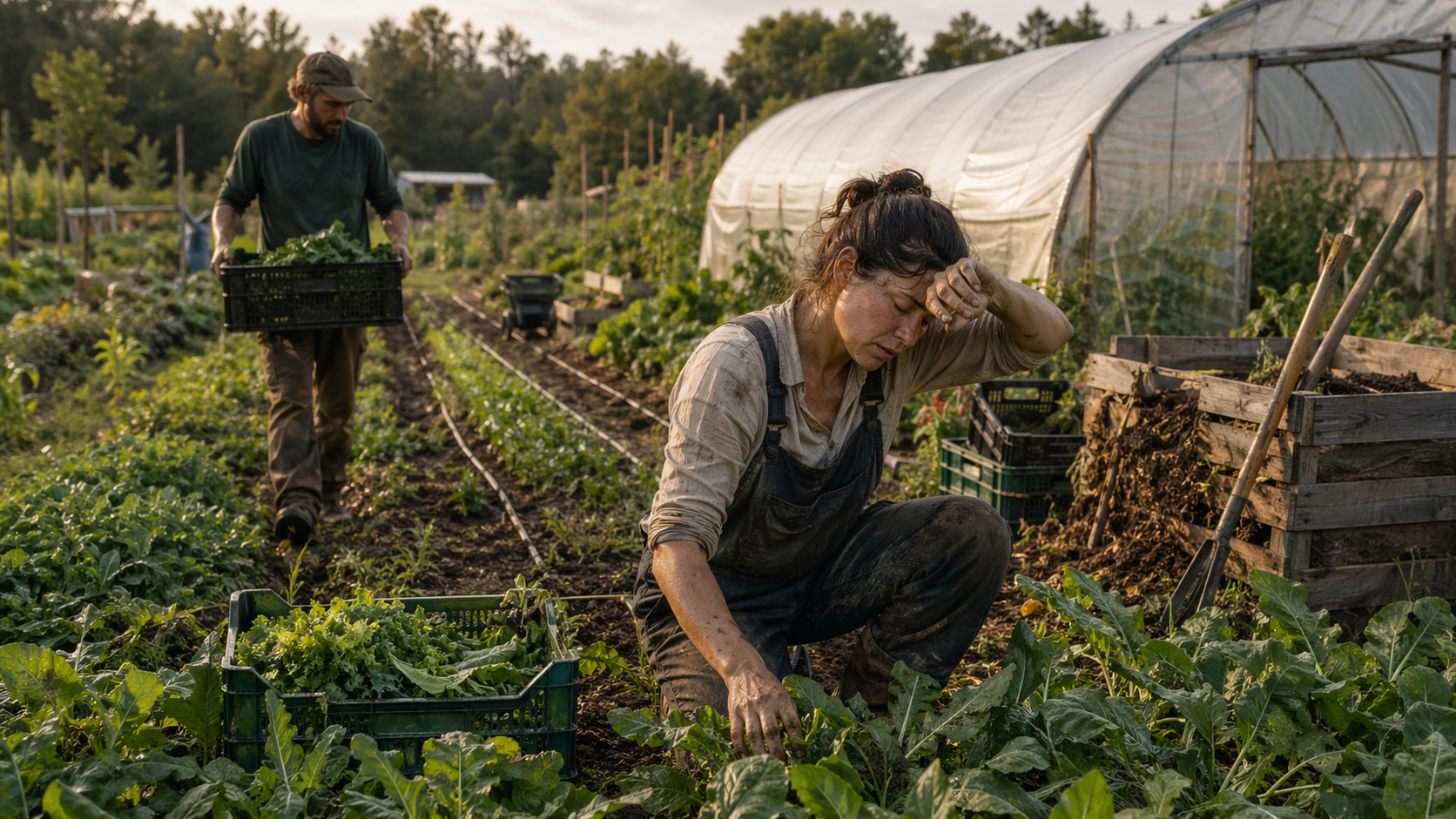
Labor Problem
Why the Labor Problem Gets Worse During Seasonal Peaks
Even more challenging, labor needs in farming are not evenly spread throughout the year. Planting, transplanting, weeding, irrigation management, harvesting, washing, packing, and market delivery can all pile up at once.
On diversified farms, those peak periods may happen again and again rather than just once or twice in a season. Therefore, sustainable farms often face repeated labor spikes that are hard to absorb with a small crew.
When that happens, delays follow. Crops may be planted late, harvested late, or lost altogether. Quality can drop. Stress rises. Then, over time, burnout becomes part of the operating model. SARE’s labor-focused guidance for diversified vegetable farms was created specifically to help farms build more durable employment systems because these labor realities are so central to farm sustainability.
Sustainable Farming Is Not Only Labor-Intensive but Also Skill-Intensive
Just as importantly, sustainable farming requires knowledge, not just effort.
Workers often need to understand soil health, plant interactions, crop timing, pest cycles, and field observation. In other words, farms do not just need more people. They need people who can make good decisions in dynamic biological systems.
That is difficult for small farms, especially when turnover is high. New workers need training. Mistakes during that learning curve can affect productivity. Larger operations may be able to divide work into narrower specialties or provide more formal training. Smaller farms usually do not have that luxury. SARE’s materials on both farm labor and farm business planning reflect how important management, training, and system design are to long-term viability.
Labor Costs Put Constant Pressure on the Business Model
Unfortunately, labor is also one of the biggest cost pressures on a farm.
If a sustainable farm does not have premium pricing, strong local market access, or direct relationships with customers, covering wages becomes much harder. USDA’s small-farm resources highlight the broader pressures on small and midsize producers, including access to markets, capital, and risk-management support. FAO likewise points to the economic vulnerabilities of small family farmers, including issues tied to assets, markets, poverty, and livelihoods.
Because of that, many farms end up making the same damaging tradeoff: they reduce labor to save money.
Yet when labor is cut, essential practices often disappear first. Compost gets postponed. Monitoring gets weaker. Weed and pest problems grow. Soil-building work loses consistency. Eventually, the system performs worse, which leads to lower productivity and more financial stress. So the farm is not failing because sustainable agriculture is impossible. It is failing because the labor required to support the system is underfunded and underplanned.
The Real Answer Is Better Design, Not Abandoning Sustainability
So what should farms do?
The most resilient farms tend to design around realistic labor capacity. Instead of trying to do everything, they simplify where possible. They choose practices that create the highest ecological and economic return for the time invested. They improve workflow, build training into operations, and adopt appropriate technology where it truly saves labor.
That approach aligns with broader support efforts from USDA and FAO, which both emphasize practical support for small and midsize producers rather than treating farm labor and management as afterthoughts. SARE’s labor initiatives go a step further by centering long-term employment quality and workable farm systems as part of sustainability itself.
In other words, the right question is not only, “Is this ecologically sound?” It is also, “Can this system actually be maintained by the people, time, and budget we have?”
That is the question that turns sustainable farming from an ideal into a functioning model.
Conclusion
Sustainable agriculture will not scale successfully if labor is treated as an unlimited resource. It is not unlimited. It is expensive, seasonal, skill-dependent, and often in short supply.
Therefore, farms that want to last must account for labor just as carefully as they account for soil, water, and crops. Ecological principles matter deeply. But so do workflow, staffing, training, business planning, and burnout prevention.
When labor constraints are ignored, even well-designed sustainable farms begin to crack. But when those constraints are addressed directly, sustainable farming becomes far more than a hopeful vision. It becomes something durable, practical, and truly scalable.
Learn More and Get Connected
If you want to explore sustainable practices with people who understand both the ecological and business realities of farming, visit EAT Community. You will find a network of people working to make agriculture more practical, resilient, and economically sound.
Helpful External Resources
- USDA National Agricultural Library: Sustainable Agriculture
- USDA NIFA: Small and Family Farms
- FAO: Small Family Farmers
- SARE: Paths to Sustainability with Farm Labor
- SARE: Collaborative Solutions to Farm Labor Challenges
- USDA: Resources for Small and Mid-Sized Farmers
References
- USDA National Agricultural Library. Sustainable Agriculture. https://www.nal.usda.gov/farms-and-agricultural-production-systems/sustainable-agriculture
- USDA National Institute of Food and Agriculture. Small and Family Farms. https://www.nifa.usda.gov/topics/small-family-farms
- Food and Agriculture Organization of the United Nations. Small Family Farmers. https://www.fao.org/family-farming/themes/small-family-farmers/en/
- Sustainable Agriculture Research and Education (SARE). Paths to Sustainability with Farm Labor. https://northcentral.sare.org/about/regional-initiatives/paths-to-sustainability-with-farm-labor/
- Sustainable Agriculture Research and Education (SARE). Collaborative Solutions to Farm Labor Challenges. https://projects.sare.org/information-product/collaborative-solutions-to-farm-labor-challenges-what-is-feasible/
- USDA. Resources for Small and Mid-Sized Farmers. https://www.usda.gov/farming-and-ranching/resources-small-and-mid-sized-farmers