
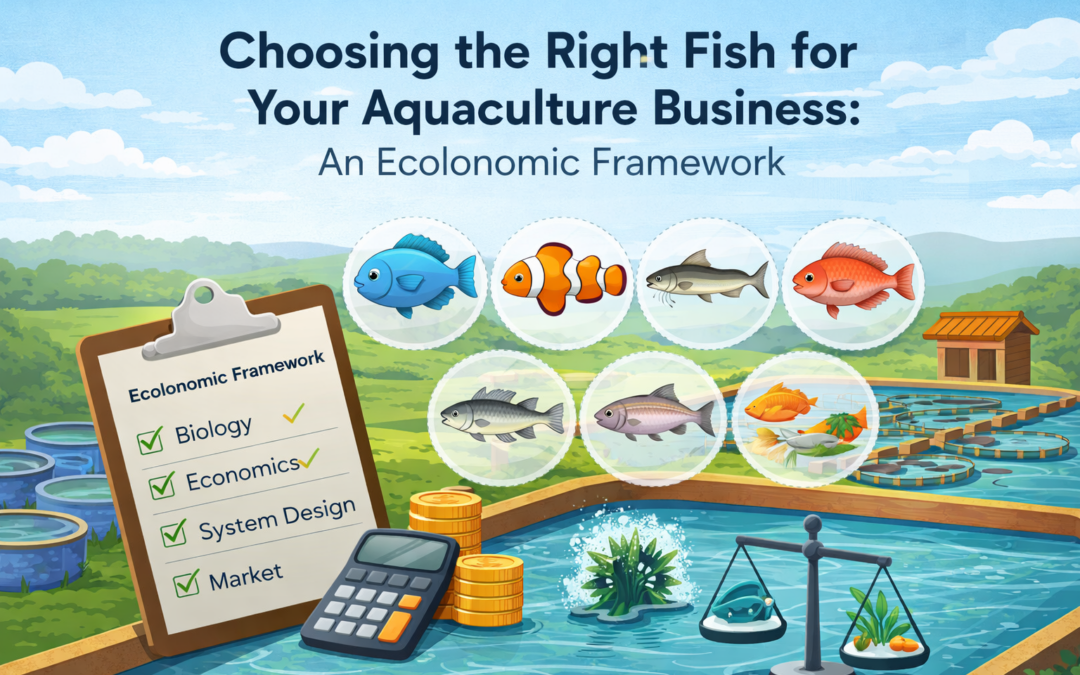
There is a question that trips up more aquaculture entrepreneurs than almost any other: which fish should I raise?
It sounds simple. It isn’t. Pick the wrong species, and you can spend years fighting high feed costs, poor survival rates, and markets that don’t want what you’re selling. Pick the right one, and you’ve given your operation a foundation it can actually build on.
The global aquaculture industry now supplies more than half of all seafood consumed by humans worldwide (FAO, 2022). That’s an enormous market. But market size doesn’t protect you from a bad species decision. Here’s a practical framework for making that choice well through an ecolonomic lens.
Start With the Business Model, Not the Biology
Most new aquaculture operators make the same mistake: they fall in love with a fish before they’ve done the math. They read about salmon prices, or they see a tilapia success story, and they start planning a farm around a species without first asking whether that species fits their situation.
The ecolonomic approach flips that order. Before you choose a fish, define your operation:
- What is your water source, temperature range, and supply reliability?
- What is your realistic capital budget — not just for startup, but for the first 18 months?
- Who are your buyers, and what species do they already purchase consistently?
- What is your management experience level?
Once you can answer those four questions, species selection becomes much more logical. The goal is to find the fish that fits your farm, your market, and your wallet — not the fish that seems most exciting.
The Core Profitability Variables
Every aquaculture species can be evaluated against five variables that determine whether it will make money in your specific operation:
1. Growth Rate
How quickly does the fish reach market size? Faster growth means shorter production cycles, lower cumulative feed cost per kilogram, and faster cash flow turnaround. Tilapia, for example, is widely valued precisely because it can reach harvest weight in a relatively short production cycle under good management conditions.
2. Feed Conversion Ratio (FCR)
FCR measures how many kilograms of feed it takes to produce one kilogram of fish. This is your most important cost metric. The FAO has consistently documented that feed management and feed conversion are central drivers of aquaculture farm economics (FAO, Feed Management in Tilapia Production). Herbivorous and omnivorous species — tilapia, catfish, carp — tend to carry lower feed costs than carnivorous species that depend on high-protein inputs.
3. Survival Rate
A species that tolerates variation in water quality, handling stress, and stocking density is a more forgiving business partner, especially for producers who are still developing their systems. Higher survival means more predictable harvests and steadier cash flow.
4. Operating Environment Fit
This is where many operators leave money on the table. Rather than forcing a species into a system that doesn’t suit it — driving up heating, aeration, filtration, and correction costs — choose a species that already thrives in your natural conditions. NOAA’s regional aquaculture guidance makes this point clearly: different ecosystems support different species, and ignoring that reality is expensive (NOAA Fisheries, Aquaculture Regional Materials).
If you’re in a warm-water region, tilapia is often the obvious answer. If you have cold, clean water, trout or salmon may be the right fit. Let your environment do the work.
5. Market Demand and Price Stability
A fish that grows beautifully but doesn’t sell is just an expensive hobby. Before you stock a single fingerling, know your buyer. Talk to restaurants, seafood wholesalers, grocery buyers, and direct consumers. Find out what species they purchase regularly, what sizes they prefer, and what price they consistently pay. Stable demand is more valuable than high prices that fluctuate.
The World Bank’s aquaculture research reinforces this: operating costs, market structure, and input efficiency are the primary determinants of sector profitability at the farm level (World Bank, Fish to 2030).

A Practical Species Overview
Here’s how the major commercial species stack up against the ecolonomic framework:
Tilapia — The most widely farmed freshwater fish in the world for good reason. Fast-growing, omnivorous (low feed cost), tolerant of crowding and water quality variation, and supported by established global markets. An excellent entry-point species for new producers in warm climates.
Catfish — Hardy, tolerant, and in strong demand across many North American markets. U.S. catfish farming has a long track record of commercial viability. Lower capital requirements to get started compared to more technical species.
Trout — Well-suited to cold, clean water environments. Strong premium market demand, especially through restaurants and specialty retail. Higher environmental sensitivity than tilapia or catfish, but very profitable in the right setting.
Carp — Underappreciated in North American markets but globally significant. Low input costs, high tolerance, and strong demand in Asian and Eastern European markets. Worth serious consideration for low-cost, high-volume production models.
Salmon — The highest price-per-kilogram of the major commercial species, but also the highest complexity, highest capital requirement, and most stringent environmental management needs. NOAA documents the specialized infrastructure requirements for Atlantic salmon production specifically (NOAA, Atlantic Salmon Aquaculture). Best suited to experienced operators with significant capital.
Barramundi — A growing premium species in North American and European markets. Warm-water tolerant, fast-growing, and increasingly favored by high-end restaurant buyers. Worth watching as market awareness grows.
The Risk Management Dimension
One aspect of species selection that doesn’t get enough attention is downside risk. Climate variability, disease pressure, and input cost swings (especially feed) can all destabilize an aquaculture operation quickly.
The FAO’s work on tilapia economics shows clearly that changes in feed cost, fish mortality, and market price can all sharply affect profitability (FAO, Markets for Tilapia). Building in resilience from the start means choosing species with tolerance for environmental variation, planning feed sourcing carefully, and not over-leveraging your capital on a single production cycle.
For new operators especially: start with hardy, forgiving species. Build your systems, your market relationships, and your management skills. Then consider expanding into higher-value, higher-complexity species once the foundation is solid.
The Ecolonomic Bottom Line
Profitable aquaculture isn’t about chasing the most expensive fish. It’s about building a production system where biology, environment, economics, and market all align.
The most resilient aquaculture operations share one trait: they chose a species that fit their actual situation, then built excellence around that choice. They didn’t try to force premium results out of conditions that couldn’t support them.
Choose your fish the way you’d choose a business partner — someone who fits your operation, performs reliably, and helps you build something that lasts.
For more practical ecolonomic strategies for aquaculture and sustainable agriculture, join us at the EAT Community.
References:
- 3 Fish to Raise in Your Backyard Fish Pond
- FAO (2022). The State of World Fisheries and Aquaculture. Link
- FAO. On-farm feed management practices for Nile tilapia. Link
- FAO. Markets for Tilapia. Link
- NOAA Fisheries. Aquaculture Overview and Regional Materials. Link
- NOAA Fisheries. Atlantic Salmon Aquaculture. Link
- World Bank (2013). Fish to 2030: Prospects for Fisheries and Aquaculture. Link