
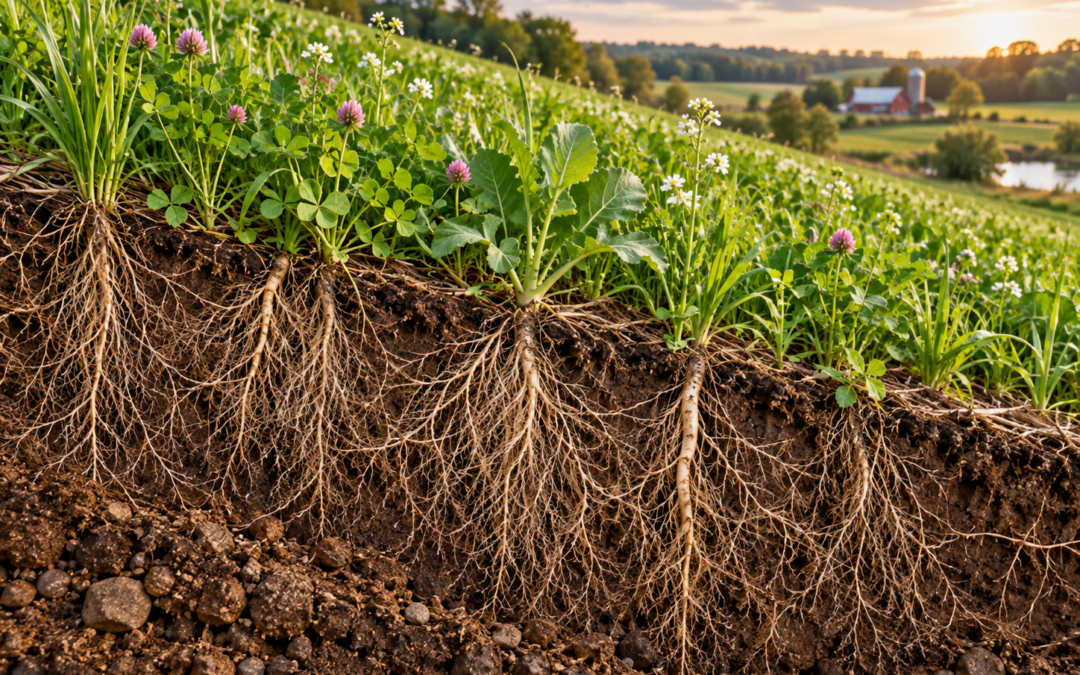
Healthy soil begins below the surface.
Plant roots do much more than hold crops in the ground. They actively shape the soil around them, creating channels, supporting microorganisms, contributing organic matter, and influencing how water and air move through the soil.
The relationship between root systems and soil structure is especially important in agriculture. Strong, diverse root systems can improve soil aggregation, water infiltration, porosity, biological activity, and resistance to erosion.
Understanding these interactions can help farmers make better decisions about cover crops, crop diversity, soil management, and regenerative agricultural practices.
Roots Create Channels in the Soil
As roots grow, they push their way through the soil and create small pathways.
These pathways are sometimes called root channels or biopores. Some remain in the soil even after the original roots die and decompose.
These channels can make it easier for water, air, and future roots to move through the soil.
Deep-rooted plants are especially valuable because they can reach compacted or deeper soil layers that shallow-rooted crops may not access as easily.
When these roots eventually decompose, the channels they leave behind may continue providing pathways through the soil.
This can gradually improve soil structure and make deeper layers more accessible to future crops.
Root Growth Improves Soil Aggregation
Healthy soil is not simply a collection of loose particles.
Soil particles often bind together into small clusters called aggregates. These aggregates help create the spaces needed for air, water, plant roots, and microorganisms.
Roots contribute to this process in several ways.
As roots grow through the soil, they physically hold particles together. Roots also release compounds into the surrounding soil that can contribute to the development of stable aggregates.
At the same time, bacteria, fungi, and other organisms living around plant roots produce substances that can help bind soil particles together.
Stable soil aggregates can help:
- Improve water infiltration
- Increase soil aeration
- Protect soil organic matter
- Support microbial life
- Improve resistance to erosion
- Create better conditions for plant roots
Good aggregation is one of the important characteristics of healthy agricultural soil.
Deep Roots Improve Soil Porosity
Soil porosity refers to the spaces between soil particles.
These spaces are essential because they allow water and air to move through the soil.
Roots can influence soil porosity by creating openings as they grow. Large and deep root systems may create channels extending far below the surface.
When roots die and decompose, some of those spaces remain.
Over time, this can help create a more porous soil environment.
Better soil porosity can support stronger root development, improved drainage, air movement, and water storage.
However, root growth is only one part of the process. Soil texture, organic matter, compaction, biological activity, and management practices also influence soil porosity.
Root Exudates Feed Soil Organisms
One of the most interesting interactions between plants and soil happens directly around the roots.
Living roots release sugars, organic acids, amino acids, and other compounds into the surrounding soil. These substances are generally known as root exudates.
The narrow zone of soil influenced by the root is known as the rhizosphere.
This area can contain large populations of bacteria, fungi, and other microorganisms.
Many of these organisms use compounds released by roots as a source of energy. In return, soil microorganisms can participate in processes such as nutrient cycling, decomposition, and interactions that influence plant nutrient availability.
A healthy root system therefore supports much more than the plant itself. It can also support an active underground biological community.
Different Roots Affect Soil in Different Ways
Plants do not all develop the same type of root system.
Some plants have dense fibrous roots concentrated near the surface. Others produce large taproots that penetrate deeply into the soil.
Each root structure can influence soil differently.
Fibrous Roots
Grasses and many cereal crops develop extensive fibrous root systems.
These roots spread through the upper soil layers and create dense networks that can help hold soil particles together.
Because fibrous roots occupy a large portion of the upper soil profile, they can be particularly useful for protecting surface soil.
Taproots
Other plants develop deeper primary roots known as taproots.
These roots may grow through deeper soil layers and create channels that can later be used by water or other plant roots.
Some cover crops are selected specifically because their root systems can explore deeper layers of the soil.
Combining plants with different root structures can therefore help influence several soil layers instead of concentrating root activity near the surface.
Dead Roots Add Organic Matter
Roots continue benefiting soil even after they die.
As dead roots decompose, they become part of the soil organic matter system.
Soil organisms break down dead root material and gradually recycle its nutrients.
This process can contribute to:
- Soil organic matter
- Nutrient cycling
- Microbial activity
- Soil aggregation
- Improved soil structure
Unlike crop residues left on the soil surface, root material is already distributed throughout the soil profile.
This means organic material is being added directly where roots once grew.
Maintaining active root systems throughout as much of the year as possible can therefore contribute to long-term soil improvement.
Roots Help Reduce Soil Erosion
One of the most visible benefits of plant roots is their ability to help hold soil in place.
Roots form networks that connect soil particles and aggregates.
This can be particularly important on sloping farmland or areas exposed to heavy rainfall and wind.
Without vegetation, rain can strike exposed soil directly and move soil particles across the surface. Wind can also remove dry, loose soil.
Plants provide two forms of protection.
Above ground, leaves and crop residue reduce the force of rainfall and wind.
Below ground, roots help stabilize the soil.
Together, these layers of protection can help reduce soil loss.
Root Systems Improve Water Infiltration
Water infiltration is the movement of water from the soil surface into the soil profile.
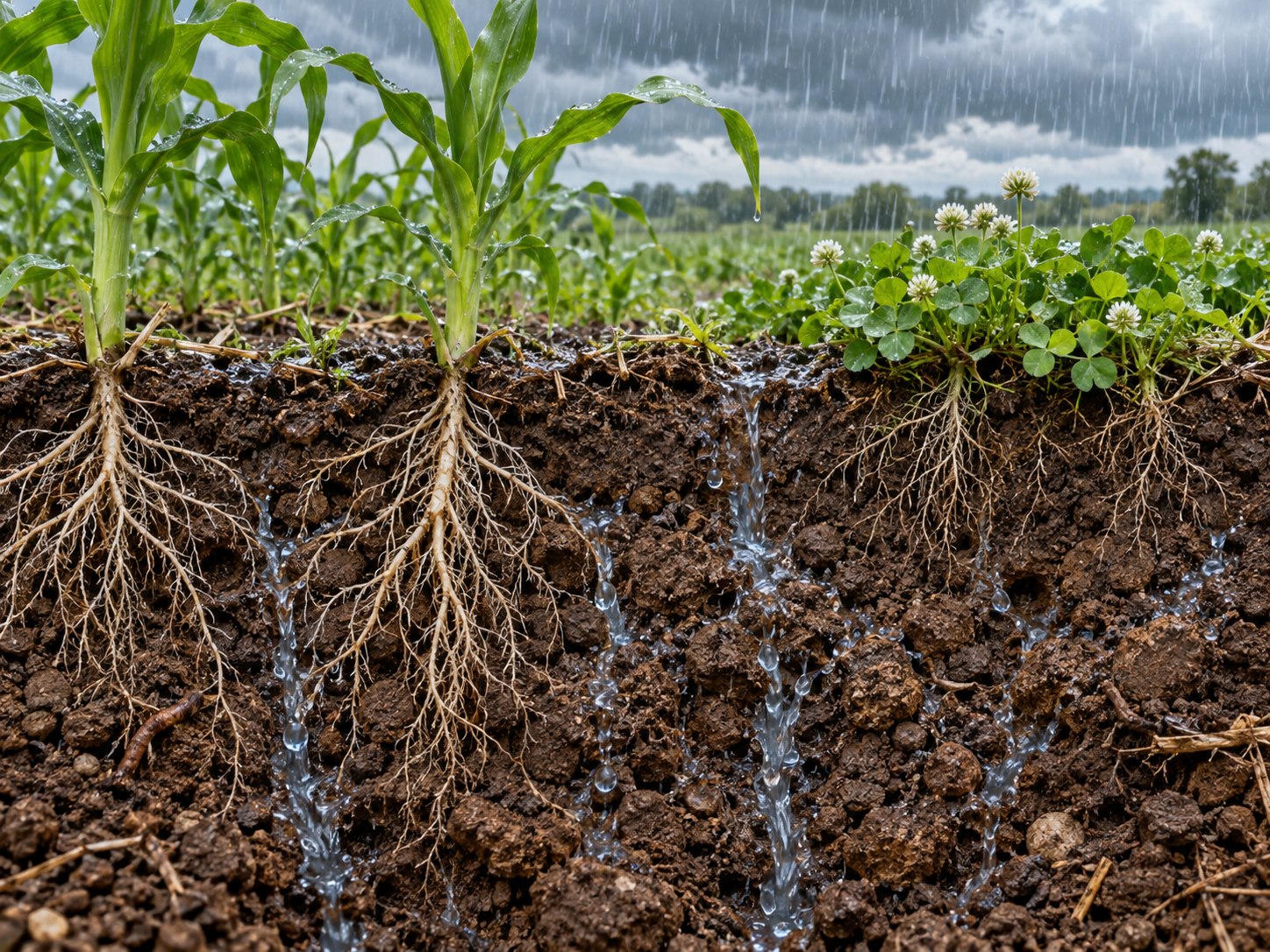
Healthy root systems can contribute to this process by creating channels and supporting soil structure.
When rain falls on poorly structured or compacted soil, a significant amount of water may move across the surface as runoff.
Well-structured soil contains pores and channels that allow more water to move downward.
Old root channels can act as pathways for water to enter deeper layers.
Better infiltration may help:
- Reduce surface runoff
- Reduce erosion
- Increase soil water storage
- Support plant growth
- Improve drought resilience
The amount of water a soil can absorb still depends on many factors, including soil texture, compaction, rainfall intensity, organic matter, vegetation, and management.
Cover Crops Help Protect the Soil
One way farmers can maintain living roots between cash crops is by planting cover crops.
Cover crops are generally planted primarily to benefit the soil rather than for harvest.
Common examples include:
- Clover
- Rye
- Oats
- Radish
- Vetch
- Peas
- Buckwheat
- Cereal rye
Different cover crops can provide different benefits.
Deep-rooted species may explore lower soil layers, while fibrous-rooted plants create dense networks closer to the surface.
Leguminous cover crops can also form relationships with nitrogen-fixing bacteria, potentially contributing nitrogen to the cropping system.
Above ground, cover crops protect the soil from rainfall and wind.
Below ground, their roots help maintain soil structure and provide energy for soil organisms.
For many regenerative farming systems, maintaining living roots for more of the year is an important soil-health strategy.
Why Root Diversity Matters
A field containing only one type of plant may also contain a relatively uniform root structure.
Increasing plant diversity can create a more complex underground environment.
Some roots remain near the surface.
Others explore intermediate soil layers.
Deep-rooted plants may extend much farther downward.
This variety can help distribute biological activity and organic inputs throughout more of the soil profile.
Diverse root systems can also support different microbial communities and use water and nutrients from different depths.
This is one reason plant diversity is commonly emphasized in regenerative agriculture and soil-health management.
Farmers may increase diversity through crop rotations, cover crop mixtures, intercropping, agroforestry, or diversified grazing systems.
Healthy Roots Begin With Healthy Soil Management
Roots can improve soil structure, but the relationship works both ways.
Plants also need suitable soil conditions to develop strong roots.
Heavy compaction, poor drainage, excessive disturbance, low organic matter, or erosion can restrict root development.
Practices that protect soil structure can therefore help plants establish better root systems.
Depending on the farming system, useful practices may include:
- Reducing unnecessary soil disturbance
- Keeping soil covered
- Maintaining living roots
- Increasing crop diversity
- Using cover crops
- Adding appropriate organic inputs
- Managing livestock carefully
- Avoiding field operations when soils are excessively wet
No single practice is appropriate for every farm.
Soil type, climate, cropping system, equipment, water availability, and economic goals all need to be considered.
Conclusion
Root systems play a major role in the development and maintenance of healthy soil.
As roots grow, they create channels, influence soil aggregation, increase pore spaces, support microorganisms, and contribute organic matter.
They can also help reduce erosion and encourage water infiltration.
Different root systems affect different parts of the soil profile, which is why plant diversity can be valuable.
Fibrous roots protect and bind upper soil layers, while deeper roots can explore lower layers and create long-lasting channels through the soil.
For farmers interested in improving soil health, focusing on what happens below the surface can be just as important as managing the crop above it.
Keeping living roots in the soil, increasing plant diversity, using cover crops, and protecting soil structure can all contribute to stronger and more resilient agricultural systems.
Interested in Regenerative Agriculture?
Are you considering moving from conventional farming toward regenerative agriculture?
The Ecolonomics Action Team (EAT Community) provides opportunities to learn about regenerative farming, soil health, sustainable agriculture, environmental business, and practical approaches that can improve both environmental and economic outcomes.
Connect with farmers, environmental professionals, entrepreneurs, and other experts who are working to build more resilient agricultural systems.
Join the EAT Community and explore practical ideas for improving the health and productivity of your land.
Sources & Further Reading
USDA Natural Resources Conservation Service — Soil Health on Cropland
Information about soil health principles, living roots, biodiversity, water infiltration, and agricultural soil management.
https://www.nrcs.usda.gov/conservation-basics/soil/soil-health/soil-health-on-cropland
USDA Natural Resources Conservation Service — Cover Crops for Soil Health
Guidance on using cover crops to protect soil, improve infiltration, reduce erosion, and support soil biology.
https://www.nrcs.usda.gov/conservation-basics/soil/soil-health/cover-crops-for-soil-health
USDA Natural Resources Conservation Service — Soil Health Management
Information about managing soil biology, plant diversity, living roots, soil cover, and reduced disturbance.
https://www.nrcs.usda.gov/conservation-basics/soil/soil-health/soil-health-management
USDA Natural Resources Conservation Service — Role of Organic Matter
An overview of how organic matter influences soil structure, biological activity, water movement, and soil function.
https://www.nrcs.usda.gov/conservation-basics/soil/soil-health/role-of-organic-matter
USDA Natural Resources Conservation Service — Cropland In-Field Soil Health Assessment Guide
A technical resource covering soil aggregation, root channels, biological activity, water infiltration, erosion, and other soil-health indicators.
https://www.nrcs.usda.gov/sites/default/files/2022-10/Cropland_InField_Soil_Health_Assessment_Guide.pdf