
A dry climate is not much protection against a leaking shower, wet crawlspace, or slow plumbing leak. That distinction is easy to overlook in the Treasure Valley, where long stretches of sunshine can make indoor mold seem like a problem associated with wetter regions. The National Weather Service describes Boise’s climate as semi-arid, with normal annual precipitation of about 11.5 inches, yet mold growth inside a building depends far more on local moisture than annual rainfall.
Mold spores are a normal part of indoor and outdoor environments, so their presence alone does not establish a building problem. Growth becomes more likely when materials such as drywall paper, wood, dust, carpet, or other organic surfaces remain damp. Two neighboring homes experiencing the same Idaho weather can therefore develop very different conditions depending on plumbing, ventilation, insulation, drainage, construction details, and maintenance history.
A Dry Climate Can Still Hide Localized Moisture
Treasure Valley homes contain many ordinary places where moisture can accumulate. Bathrooms with poor exhaust ventilation may experience repeated condensation, failed shower or bathtub seals can wet concealed wall materials, and crawlspaces may receive moisture from plumbing leaks, exposed soil, irrigation, or drainage problems. Finished below-grade spaces also deserve attention because water can enter through foundation assemblies or remain concealed behind interior finishes.
Winter creates another set of conditions. Warm indoor air contacting cold windows, exterior walls, or poorly insulated surfaces can produce condensation, particularly behind furniture and inside closets where air movement is limited. EPA recommends keeping indoor relative humidity below 60%, and ideally between 30% and 50% to help reduce condensation and mold growth.
The timing of drying is also important. EPA advises that wet or damp materials should generally be dried within 24 to 48 hours; when that happens, mold growth can often be prevented. A small plumbing leak hidden inside a wall for several weeks is therefore a very different building condition from a spill that is discovered and dried immediately.
There is no comprehensive Treasure Valley housing survey that establishes what percentage of homes in Boise, Meridian, Nampa, or Caldwell have mold problems. Assigning a regional percentage without such data would be misleading. The practical point is simpler: even in a semi-arid climate, a small area inside a building can remain wet enough to support mold while the rest of the house remains dry.
Warning Signs Often Point Back to Water
Property owners should pay attention to recurring water staining, swollen baseboards, softened drywall, peeling finishes, persistent musty odors, or discoloration that returns after cleaning. EPA notes that hidden mold may be suspected when a building smells moldy but the source cannot be seen, or when there has been known water damage. Mold may develop behind drywall, wallpaper, paneling, ceiling materials, or carpeting where it is not obvious from the occupied space.
A recurring problem deserves more attention than a small isolated spot on a readily cleanable surface. The important questions are where the moisture originated, how long materials remained wet, whether the moisture source is still active, and whether water traveled into concealed spaces. Simply cleaning visible discoloration without correcting the water source leaves the conditions that allowed the problem to develop.
Health concerns should also be handled carefully. CDC reports that exposure to damp and moldy environments can cause symptoms including stuffy nose, sore throat, coughing, wheezing, eye irritation, and skin irritation, although some people experience no symptoms. People with asthma or mold allergies may experience stronger reactions, and symptoms themselves cannot establish that mold is present in a particular building.
A Useful Investigation Starts With Moisture
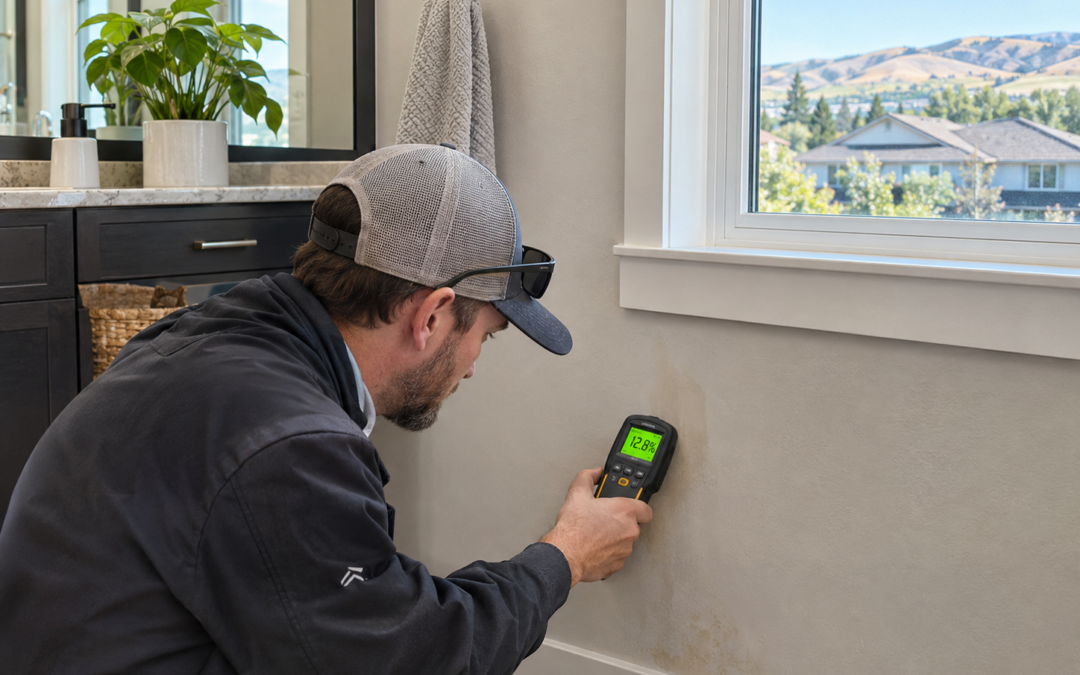
A building assessment should begin by asking where water might be entering and why materials are not drying. Visual inspection and moisture meters can help identify patterns that deserve closer examination. Infrared imaging may help locate temperature differences that warrant investigation, but a thermal image alone should not be treated as proof of mold.
Where conditions justify it and access is authorized, limited investigation of concealed spaces can help determine whether moisture has affected materials behind finishes. The purpose is to understand the building condition, not simply to collect the largest possible number of measurements. EPA guidance says that when visible mold is already present, sampling is usually unnecessary simply to confirm that mold exists.
That guidance is particularly important when homeowners are told that one air sample can certify a building as either “safe” or “unsafe.” EPA states that no federal standards or threshold limits have been established for airborne mold or mold spores. Sampling can be useful for specific questions when it is designed and interpreted by someone with appropriate experience, but results must be considered alongside moisture history, building conditions, sampling locations, and the limitations of the method.
In many investigations, finding and correcting the water source provides more useful information than collecting samples without a clearly defined purpose. If the underlying leak, drainage problem, condensation source, or ventilation problem continues, mold may return even after affected surfaces have been cleaned.
Fix the Moisture Problem, Not Just the Mold
Effective mold control begins with moisture control. Plumbing leaks should be repaired, exterior drainage should direct water away from the building, bathrooms and other moisture-producing spaces should be ventilated appropriately, and wet materials should be dried promptly. EPA specifically recommends ensuring that the ground slopes away from the foundation so water does not collect around the building.
Some situations can be handled relatively simply, while recurring growth, concealed moisture, extensive affected materials, or an unknown water source may justify a more detailed building investigation. People with asthma, allergies, or other respiratory conditions may require additional caution; CDC advises that people with asthma or other lung conditions should avoid buildings with indoor water leaks or mold growth that can be seen or smelled.
For Treasure Valley property owners, the goal should not be to prove that a single mold spore exists. Mold spores are common. The more useful questions are whether building materials have been persistently wet, how far the moisture traveled, whether damaged materials need attention, and what must be corrected to prevent the condition from returning.
If you are dealing with recurring moisture, suspected hidden mold, or an indoor environmental concern in Boise, Meridian, Nampa, Caldwell, or elsewhere in the Treasure Valley, Summit Environmental: https://www.summitenvironmentalinc.com/ can help evaluate the building conditions and identify practical next steps. A focused assessment should explain what is happening in the building, where the moisture is coming from, and what needs to be addressed—not simply report whether a mold spore was detected. Check it out at https://www.summitenvironmentalinc.com/