
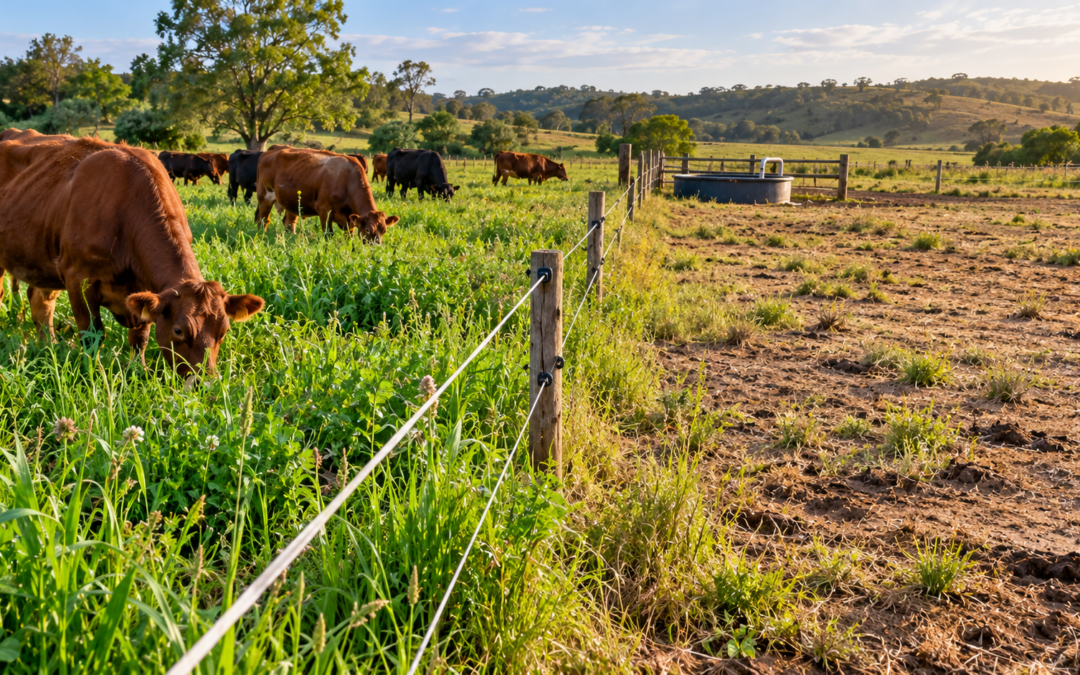
Degraded pastureland often shows the same warning signs: thinning vegetation, bare soil, compacted surfaces, poor water infiltration, declining forage production, and increasing weed pressure. When grazing demand continually exceeds the land’s ability to recover, roots weaken and the soil becomes less capable of storing the water and nutrients needed for productive forage.
Regenerative pasture management focuses on restoring those functions rather than simply producing more grass in the short term. USDA Natural Resources Conservation Service guidance emphasizes four broad principles for pasture soil health: optimize disturbance, optimize soil cover, optimize biodiversity, and maximize continuous living roots. Applied together, these principles can help land managers rebuild vegetation, soil structure, nutrient cycling, and water-holding capacity.
Managed Grazing Gives Plants Time to Recover
Continuous grazing can repeatedly remove leaves before plants have rebuilt their root reserves. When animals remain too long in one area or stocking rates exceed available forage, desirable grasses become weaker while bare ground and less productive species can expand. Rotational or adaptive grazing breaks this cycle by moving animals among paddocks and giving grazed plants time to regrow.
NRCS explains that rotational grazing separates pasture into paddocks so animals regularly move onto fresh forage. Paddock size and grazing duration depend on herd size, season, forage quantity, and plant growth. The purpose is not simply frequent movement; it is to match grazing pressure with the pasture’s ability to recover.
Rest periods need to change with growing conditions. Grass recovery is usually faster during warm, moist periods and slower during drought or cool weather. NRCS grazing guidance summarizes the principle as rotate, rest, recover, and maintain an appropriate stocking rate, because plants need enough remaining leaf area and root reserves to rebuild after grazing.
Restoring Cover Improves Soil and Water Function
Bare soil loses water and nutrients more easily than well-covered pasture. Rainfall can strike exposed soil directly, break apart surface aggregates, and move sediment downslope, while heat and evaporation reduce moisture available to plants. Maintaining grasses, legumes, plant residue, and living roots protects the soil surface and supports continued biological activity below ground.
NRCS notes that well-managed pasture soils are better able to capture, store, and redistribute water while cycling nutrients and supporting plant growth. The agency also explains that overgrazing reduces infiltration, increases runoff, and leaves less water available to plants. This creates a downward cycle in which declining plant production leads to even greater grazing pressure on the vegetation that remains.
Ground cover also helps moderate soil temperature. NRCS reports that a temperature difference of 15°F or more can occur between well-covered soil and poorly covered soil. Cooler, protected soil can support better biological activity and reduce moisture loss during hot conditions.
Legumes and Plant Diversity Can Improve Pasture Fertility
Restoring degraded pasture does not always mean reseeding with a single grass species. A mixture of grasses, legumes, and suitable forbs can extend the grazing season, improve forage quality, and create a more diverse root system. Different plants also use water and nutrients differently, helping make the pasture more resilient to changing conditions.
Legumes are particularly valuable because bacteria associated with their roots fix atmospheric nitrogen. Mississippi State University Extension reports that forage legumes can provide approximately 50 to 80 pounds of nitrogen per acre in mixed pasture systems. This biological nitrogen can reduce the amount of supplemental fertilizer needed while improving forage protein and feeding value.
In well-established stands, the contribution can be even larger. Mississippi State notes that pastures containing about 30% to 40% legumes often do not require commercial nitrogen fertilizer, depending on species, soil fertility, and management. Legume selection should still match rainfall, drainage, soil pH, and grazing system because poorly adapted species will not provide consistent benefits.
Reducing Compaction Helps Roots and Rainfall Move Deeper
Livestock traffic can compact soil, especially when animals repeatedly gather around gates, shade, feeders, or water points. The risk increases when soils are wet because hoof pressure can compress pores and damage aggregates. Compacted soil restricts root growth, reduces aeration, and prevents rainfall from moving readily into the profile.
NRCS technical guidance explains that livestock trampling can increase soil bulk density, reduce infiltration, increase runoff, and increase erosion risk, particularly when high-intensity traffic is repeated on moist soils. Avoiding vulnerable areas during wet periods and distributing water, minerals, shade, and grazing pressure more evenly can reduce those concentrated impacts.
Good grazing management can gradually improve these conditions. NRCS reports that a properly managed pasture with rotational grazing and adequate rest periods generally has less compaction and better water infiltration than continuously grazed pasture. Mechanical aeration or renovation may occasionally be useful, but it will provide only temporary relief if excessive stocking or repeated hoof traffic continues.
Restoring degraded pastureland is therefore less about one treatment than about changing the system that caused degradation. Managed grazing, adequate recovery periods, continuous soil cover, deeper living roots, diverse forage species, legumes, and reduced compaction can reinforce one another over time. Consistent monitoring of forage production, ground cover, soil condition, water infiltration, and stocking pressure allows land managers to adjust before the pasture begins declining again.
Join the EAT Community at https://www.eatcommunity.com/ to learn from experienced farmers and explore practical strategies for regenerative farming.