
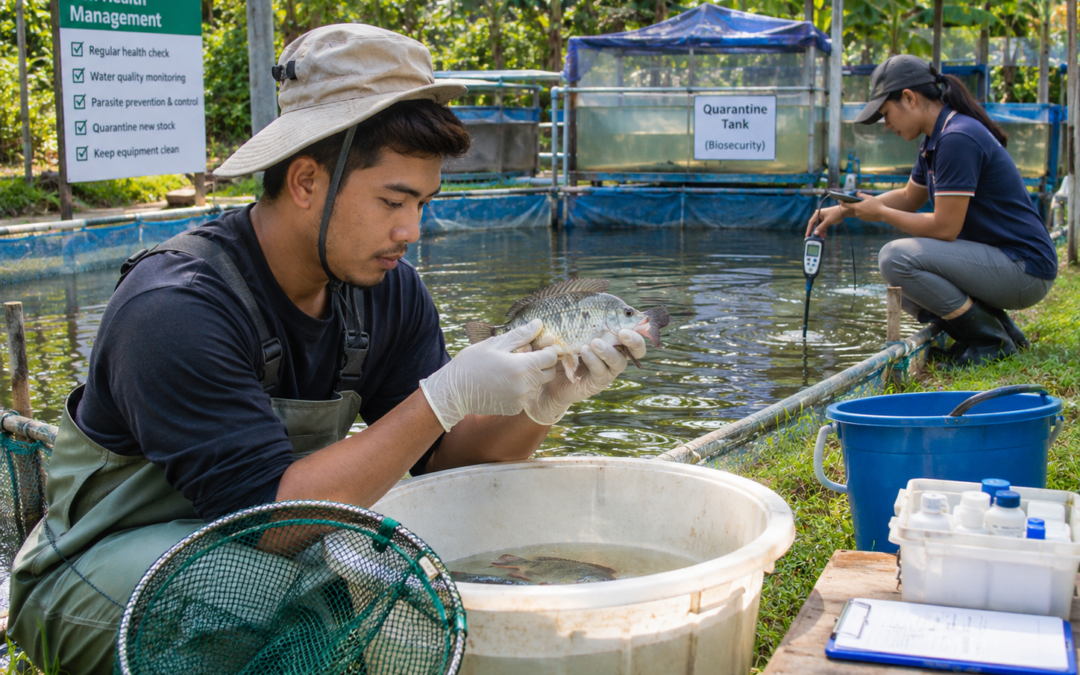
Parasites are a common fish-health concern in aquaculture because intensive production brings animals into close contact and can create conditions where infectious organisms spread quickly. Affected fish may show reduced feeding, lethargy, rubbing against surfaces, excess mucus, labored breathing, skin lesions, or unexplained mortality. These signs are important, but they are not unique to parasites, so good management starts with observation and diagnosis rather than assuming every sick fish needs the same treatment.
One of the better-known examples is Ichthyophthirius multifiliis, commonly called Ich or white spot disease. University of Florida IFAS describes Ich as a protozoan parasite capable of causing rapid and severe losses in freshwater fish. The parasite can enter a farm with new fish, plants, substrates, or contaminated equipment, which is why prevention and biosecurity are just as important as treatment.
Watch Fish Closely and Confirm the Cause
Early recognition gives farmers more options before an outbreak becomes severe. Fish that begin rubbing against tank walls, producing excess mucus, swimming erratically, breathing rapidly, or gathering near water inlets should be examined promptly. Changes in feeding behavior and unexpected mortalities should also be recorded because they may be the first signs of a developing health problem.
Visible white spots may suggest Ich, but many parasites cannot be identified accurately by appearance alone. UF/IFAS recommends sampling newly introduced or sick fish for external parasites using skin scrapes, fin clips, and gill clips when appropriate. Microscopic examination can help distinguish parasitic disease from bacterial problems, poor water quality, or physical injury.
Diagnosis matters because treatment depends on the organism involved. Ich, monogenean flatworms, crustacean parasites, and internal worms differ in life cycle and susceptibility to treatment. Using a chemical simply because it is available can waste time, stress fish, and expose the farmer to unnecessary cost or regulatory problems.
Good Water Quality and Stocking Reduce Stress
Parasites are easier to manage when fish are not already stressed by poor environmental conditions. Dissolved oxygen, temperature, pH, ammonia, nitrite, and organic waste all influence fish health. UF/IFAS notes that temporary increases in ammonia or nitrite and other water-quality fluctuations can suppress fish immune function and increase susceptibility to pathogens.
High stocking density adds another layer of risk. Intensive systems can concentrate fish, waste, biofilms, and pathogens in a relatively small volume of water, making transmission easier. UF/IFAS identifies higher fish densities, accumulated sediment and biofilms, and slower water turnover as factors that can allow disease-causing organisms to build up in recirculating systems.
Small-scale farmers should therefore avoid pushing stocking densities beyond what the water, aeration, filtration, and feeding system can safely support. Uneaten feed and fecal material should be removed where practical, and water-quality measurements should be recorded regularly. Stable environmental conditions will not eliminate parasites, but they reduce stress and help fish maintain stronger defenses.
Quarantine New Fish and Keep Equipment Separate
Introducing new fish is one of the easiest ways to bring parasites onto a farm. UF/IFAS specifically recommends that recently arrived fish be quarantined and screened for pathogens before they are introduced into established production systems. Even apparently healthy fish can carry organisms that become a problem after transport stress or when they enter a new population.
Ich is a good example. UF/IFAS reports that it can be introduced through new fish, plants, substrates, or contaminated equipment, and surviving fish may remain carriers. A separate holding area therefore gives farmers time to observe new stock and identify problems before the main production unit is exposed.
Biosecurity should also apply to equipment. Nets, buckets, sampling tools, boots, and other items can move water and pathogens between tanks or ponds. Where possible, farms should dedicate equipment to individual groups or clean and disinfect it before moving from one production unit to another.
Quarantine does not need to be complicated to be useful. The key is physical separation, observation, clean equipment, and enough time to detect signs of disease before fish are mixed with the main stock. Farms that repeatedly introduce fish from multiple sources should place particular emphasis on this step.
Use Treatments Only After the Parasite Is Identified
Treatment should match the parasite, fish species, production system, water chemistry, and severity of the outbreak. Some parasites respond to salt, formalin, or other approved treatments, while others require very different approaches. UF/IFAS explains that salt can effectively control some external protozoan parasites, but concentration and exposure time are critical and some fish species tolerate salt poorly.
This is why salt should not be treated as a universal remedy. UF/IFAS notes that a 3% salt dip can remove some protozoa from freshwater fish, while weaker solutions may be used for longer exposure periods. The same guidance recommends a bioassay when species tolerance is uncertain, because an inappropriate dose can harm fish.
Other chemicals require even greater care. Formalin, for example, is used against some external parasites, but application depends on fish species, temperature, oxygen conditions, and the specific parasite involved. UF/IFAS maintains current guidance on the use of formalin to control fish parasites, reinforcing the need to follow expert recommendations and product directions rather than improvising treatments.
Farmers should also keep records of outbreaks, treatments, mortalities, water quality, fish source, and response to therapy. UF/IFAS recommends routine recording of water-quality measurements, fish behavior, feeding, and mortality, because patterns in those records can help identify recurring problems and improve future prevention.
Parasite control works best as a system rather than a single treatment. Regular observation, stable water quality, appropriate stocking density, quarantine, clean equipment, accurate diagnosis, and carefully selected treatments all reduce the chance that a minor infection becomes a major production loss. Preventive management may require more attention upfront, but it is usually less disruptive than responding to a severe outbreak after fish are already stressed.
Join the EAT Community at https://www.eatcommunity.com/ to learn from experienced farmers and explore practical strategies for sustainable aquaculture and fish-farm management.