
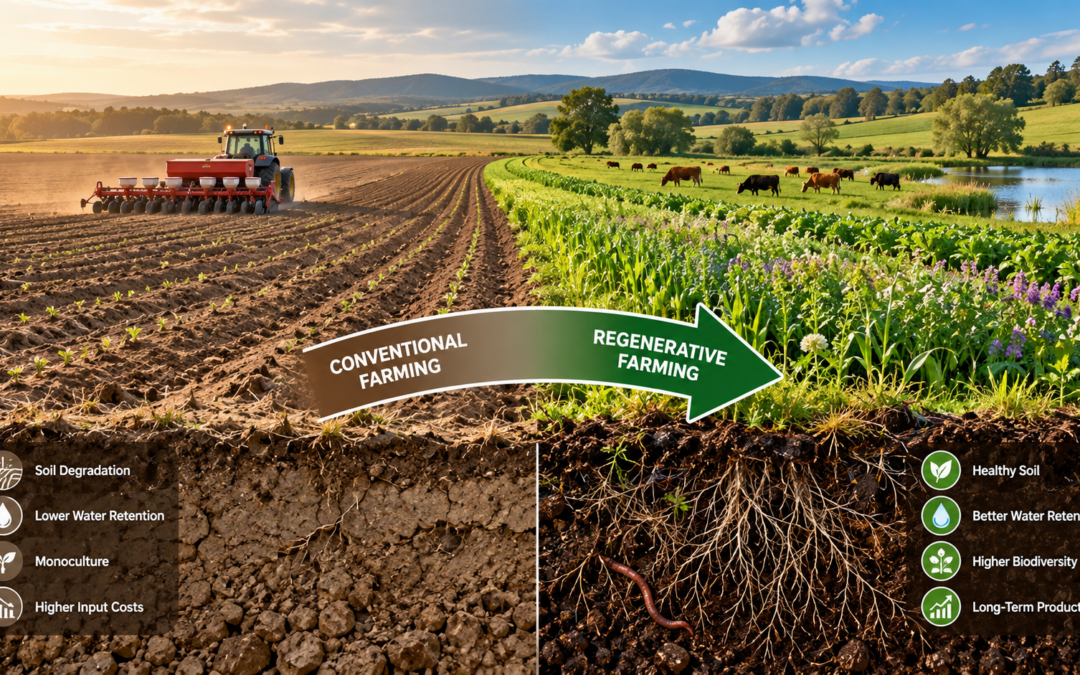
Moving from conventional farming to regenerative farming is less about replacing one system overnight and more about changing how soil, crops, water, livestock, and farm inputs are managed over time. The goal is to maintain productive agriculture while improving soil function, reducing erosion, supporting biodiversity, and making better use of rainfall and nutrients. USDA Natural Resources Conservation Service guidance organizes soil-health management around four principles: minimize disturbance, maximize soil cover, maximize biodiversity, and maintain continuous living roots.
The transition should fit the individual farm rather than follow a rigid formula. Soil type, rainfall, crops, equipment, livestock, markets, labor, and financial conditions all influence which practices make sense and how quickly they should be introduced. Starting with a clear baseline allows farmers to make changes deliberately and judge whether those changes are improving the farm.
Start With the Farm You Have
Before changing practices, farmers should understand current soil and production conditions. Useful starting points include soil structure, organic matter, nutrient status, erosion, compaction, water movement, yields, input use, and operating costs. USDA NRCS Soil Technical Note 1A recommends examining approximately the top 1 to 2 feet of soil when evaluating organic matter, structure, roots, microorganisms, and crop residue.
That same NRCS technical note specifically recommends using “baby steps” when moving toward better soil health. This is important because regenerative practices interact with existing equipment, weed pressure, nutrient availability, crop rotations, and local weather. Testing cover crops or reduced tillage on part of the farm first can provide useful information without placing the entire year’s production at risk.
A baseline also makes progress measurable. Farmers can record soil tests, infiltration, visible erosion, crop yields, input costs, water use, and field observations before making major changes. Repeating those measurements over several seasons makes it easier to determine whether a new practice is actually improving soil function and farm performance.
Reduce Disturbance and Keep Soil Covered
Repeated tillage can disrupt soil aggregates, reduce pore space, accelerate organic-matter loss, and expose bare soil to wind and water erosion. NRCS explains that long-term soil-health management begins by disturbing soil as little as practical while keeping it covered. Farmers may move toward fewer tillage passes, strip tillage, reduced tillage, or no-till depending on soil conditions, crops, weed management, and available equipment.
Cover crops provide one of the most useful tools during this transition because they protect soil between cash crops and maintain living roots for more of the year. The USDA NRCS Cover Crop Conservation Practice Standard 340 establishes science-based criteria for using grasses, legumes, and other herbaceous plants to reduce erosion, build organic matter, improve nutrient cycling, support water infiltration, and suppress weeds.
Organic matter should also be protected and rebuilt gradually. Crop residues, roots, compost, properly managed manure, and cover crops supply carbon and nutrients to soil organisms while contributing to aggregation and moisture retention. The objective is not simply to add as much organic material as possible, but to combine residue management, living roots, reduced disturbance, and appropriate nutrient management so the soil system improves over time.
Increase Diversity and Manage Water and Livestock Together
Regenerative systems generally use greater biological diversity than simple monocultures. Crop rotation, cover-crop mixtures, intercropping, perennial plants, and livestock integration create different root systems and residues throughout the farm. NRCS states that increasing diversity in crop rotations and cover crops improves soil health and helps reduce pest and disease problems associated with monocultures.
Greater soil cover and root activity can also improve how rainfall enters and remains in the soil. Mulch, crop residue, cover crops, contour practices, and perennial vegetation reduce exposure to raindrop impact and slow surface runoff. NRCS notes that keeping soil covered helps conserve moisture, moderate soil temperatures, and improve water infiltration, which can become particularly valuable during periods of limited rainfall.
Livestock can contribute to nutrient cycling when grazing is managed carefully. NRCS recommends rotational grazing rather than continuous grazing because allowing pasture plants time to rest and regrow can reduce environmental impacts. On rangelands, NRCS also notes that properly managed grazing can incorporate plant litter into the soil and contribute organic matter, while overgrazing can reduce root mass, increase runoff, and leave soil more vulnerable.
Reduce Inputs Carefully and Measure What Changes
Regenerative agriculture is sometimes presented as a rapid move away from fertilizers, pesticides, or other purchased inputs, but abrupt reductions can create production problems when soil fertility or biological functions are not yet able to compensate. A better approach is to reduce unnecessary inputs as soil function, crop rotation, pest management, and nutrient cycling improve. Soil testing and field observations should guide those decisions rather than assuming that eliminating an input automatically improves the farm.
Crop diversity can help farmers make that transition more strategically. The USDA Conservation Stewardship Program includes a named Soil Health Crop Rotation enhancement, E328E, designed to improve cropland soil health by increasing plant diversity and minimizing soil disturbance. Programs such as this demonstrate that regenerative practices can be planned and documented as part of a broader conservation system rather than adopted as isolated techniques.
Monitoring should continue throughout the transition. Farmers can compare crop yields, soil-test results, infiltration, organic matter, erosion, input costs, water use, grazing conditions, and profitability from season to season. Regenerative farming requires patience because soil properties and biological communities do not change overnight, but careful measurement allows farmers to identify which practices deserve expansion and which need adjustment.
Transitioning from conventional to regenerative farming works best as an adaptive process rather than a sudden conversion. By starting with current farm conditions, reducing disturbance, maintaining soil cover, increasing plant diversity, managing water and livestock carefully, and changing external inputs only when conditions support it, farmers can build a system that becomes more resilient without unnecessarily putting production at risk.
Join the EAT Community at https://www.eatcommunity.com/ to learn from experienced farmers and explore practical strategies for regenerative farming.