
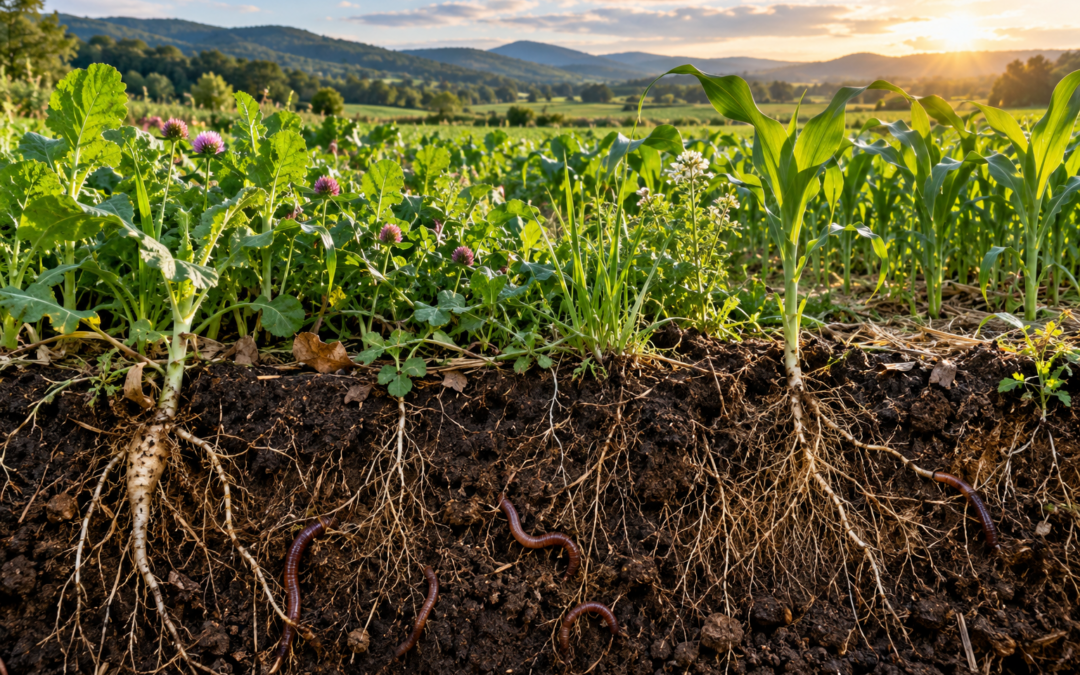
Healthy topsoil is one of a farm’s most valuable resources.
It is the upper layer of soil where much of the biological activity, organic matter, nutrient cycling, and root growth that support crop production take place.
Yet topsoil can also be vulnerable.
Wind and water erosion, excessive disturbance, declining organic matter, compaction, and long periods without living plants can gradually reduce its ability to function.
Regenerative farming focuses on managing agricultural land in ways that protect and improve these soil functions over time.
Practices such as keeping soil covered, minimizing unnecessary disturbance, maintaining living roots, increasing plant diversity, adding appropriate organic materials, and supporting soil organisms can all contribute to building healthy topsoil.
The goal is not simply to increase one soil measurement.
It is to create a more functional living soil system that can support plants, water movement, nutrient cycling, and agricultural productivity.
Keep the Soil Covered
Bare soil is exposed soil.
Without protective vegetation or crop residue, the soil surface is more vulnerable to wind, rainfall impact, erosion, evaporation, and extreme temperature changes.
Maintaining soil cover is therefore one of the most basic principles of regenerative soil management.
Farmers can protect the soil using:
- Cover crops
- Crop residues
- Mulch
- Living vegetation
- Carefully managed plant litter
These materials form a protective layer between the soil and the environment.
During heavy rainfall, cover reduces the direct force of raindrops striking soil aggregates.
During windy conditions, plant material helps keep loose particles from being carried away.
Cover can also reduce water loss from evaporation and moderate soil temperatures.
Over time, decomposing plant residues can contribute organic material to the soil.
Reduce Unnecessary Soil Disturbance
Soil is not simply an inert growing medium.
It contains aggregates, pores, roots, fungal networks, microorganisms, insects, and other living organisms.
Repeated or intensive physical disturbance can disrupt that structure.
Tillage can break soil aggregates apart and temporarily expose protected organic matter to rapid decomposition.
Repeated passes with heavy equipment may also contribute to compaction under certain conditions.
This does not mean that all tillage is inherently harmful or that every farmer should immediately stop tilling.
Soils, crops, climates, weeds, equipment, and farming systems differ considerably.
The principle is to minimize unnecessary disturbance while maintaining a productive farming system.
Depending on the operation, farmers may consider:
- No-till
- Reduced tillage
- Strip tillage
- Fewer field passes
- Controlled traffic
- Avoiding field work when soils are excessively wet
Reducing disturbance can give soil aggregates, roots, fungi, and other organisms more opportunity to develop stable structures.
Grow Cover Crops
Cover crops are planted primarily to benefit the soil rather than for direct harvest.
They are often grown between cash crops or during periods when fields would otherwise remain bare.
Common cover crops include:
- Cereal rye
- Oats
- Clover
- Vetch
- Peas
- Radish
- Buckwheat
- Annual grasses
Different cover crops provide different benefits.
Grasses may develop extensive fibrous roots.
Legumes can form relationships with nitrogen-fixing bacteria.
Deep-rooted species may explore lower portions of the soil profile.
Other species may help suppress weeds or produce large quantities of residue.
Cover crops can help protect soil from erosion while maintaining living roots and contributing organic material.
USDA NRCS identifies reduced erosion, improved water infiltration, increased organic matter, nutrient cycling, and weed suppression among common potential benefits of cover crops.
Maintain Living Roots
Living roots are an important source of energy for the soil ecosystem.
Plants release sugars and other carbon-containing compounds through their roots into the surrounding soil.
This area around the roots is known as the rhizosphere.
The rhizosphere can support intense microbial activity.
Bacteria, fungi, and other organisms interact with living roots and participate in processes such as nutrient cycling and organic matter decomposition.
Roots also physically influence the soil.
As they grow, they:
- Create channels
- Explore pore spaces
- Help stabilize soil aggregates
- Contribute organic matter after they die
- Influence water and air movement
Keeping living plants in the field for more of the year extends the period during which these below-ground interactions can occur.
Cover crops, perennial plants, longer crop rotations, and relay cropping are among the ways farmers may extend the living-root period.
Build Soil Organic Matter
Organic matter is one of the key components of healthy topsoil.
It comes from plant residues, dead roots, microorganisms, manure, compost, and other biological materials.
Soil organisms gradually decompose these materials.
During this process, nutrients are transformed and recycled.
Organic matter can also contribute to soil aggregation and water-holding capacity.
Potential sources of organic material include:
- Crop residues
- Cover crops
- Compost
- Properly managed manure
- Dead roots
- Plant litter
However, more organic input is not automatically better.
Manure and compost should be applied according to crop needs, soil-test information, nutrient content, and environmental considerations.
Excessive applications can lead to nutrient losses or water-quality problems.
The goal is to build soil organic matter gradually while maintaining nutrient balance.
Increase Crop Diversity
Growing the same crop repeatedly can simplify both the above-ground and below-ground ecosystem.
Increasing plant diversity introduces different root structures, residues, nutrient demands, and biological interactions.
Farmers can increase diversity through:
- Crop rotations
- Cover-crop mixtures
- Intercropping
- Relay cropping
- Perennial crops
- Integrated crop-livestock systems where appropriate
Different plants support different microbial communities.
Some develop shallow fibrous roots.
Others send roots deeper into the soil.
Different crops also leave behind different residues.
Greater crop diversity can help interrupt some pest and disease cycles while increasing the variety of resources entering the soil ecosystem.
USDA NRCS emphasizes that diversity above ground can help increase biological diversity below ground and support nutrient, energy, and water cycling.
Encourage Soil Organisms
Healthy topsoil contains an enormous community of organisms.
These can include:
- Bacteria
- Fungi
- Earthworms
- Protozoa
- Nematodes
- Arthropods
- Insects
- Other microorganisms
These organisms perform many different functions.
Some break down plant residues.
Others participate in nutrient cycling.
Earthworms and other soil animals create channels.
Fungi form networks through the soil and can interact with plant roots.
Microorganisms transform nutrients into different chemical forms.
Farmers do not usually need to manage each organism individually.
Instead, management can focus on creating habitat conditions that support a diverse soil community.
That generally means providing food through living roots and organic materials while limiting unnecessary disturbance.
Improve Soil Aggregation
Healthy topsoil often has a crumb-like structure made up of stable aggregates.
Aggregates are groups of soil particles bound together through physical, chemical, and biological processes.
Good aggregation creates pore spaces between soil particles.
Those pores allow:
- Water infiltration
- Air movement
- Root growth
- Biological activity
Roots, fungal hyphae, microbial compounds, organic matter, and soil chemistry all influence aggregation.
Management practices that protect soil structure and support organic matter can gradually encourage more stable aggregates.
This is one reason reduced disturbance, living roots, and organic inputs are often used together rather than as isolated practices.
Improve Water Infiltration and Retention
Healthy topsoil plays an important role in managing rainfall.
When soil contains stable aggregates and connected pore spaces, water can move downward rather than immediately running across the surface.
Organic matter can also contribute to water retention.
Better infiltration does not mean that healthy soil can absorb unlimited rainfall.
Extremely intense storms can still produce runoff and erosion.
However, improved soil structure can increase the amount of water that enters and remains within the soil profile.
This can benefit crops during dry periods.
It can also reduce surface runoff under suitable conditions.
Reduce Soil Erosion
Topsoil can take a long time to develop but can be lost quickly.
Water erosion can carry soil downhill and into waterways.
Wind erosion can move dry particles away from fields.
Because the upper soil layers often contain high concentrations of organic matter and nutrients, topsoil loss can reduce long-term productivity.
Erosion-control practices may include:
- Maintaining vegetation
- Using cover crops
- Leaving crop residue
- Mulching
- Contour farming
- Terracing where appropriate
- Grass waterways
- Buffer strips
- Windbreaks
- Maintaining stable soil structure
No single practice works everywhere.
Slope, rainfall, wind exposure, soil type, crop system, and equipment all influence erosion risk.
Protect Topsoil From Compaction
Compaction is another important soil-health concern.
Heavy equipment, repeated traffic, livestock pressure, or field operations performed when soil is too wet can compress pore spaces.
Compacted soil can restrict:
- Root growth
- Water infiltration
- Air exchange
- Biological activity
Avoiding unnecessary traffic and working soil under appropriate moisture conditions can help limit compaction.
Deep-rooted plants may also explore compacted layers, although severe compaction may require additional management.
Prevention is usually easier than correcting a heavily compacted soil later.
Regenerative Farming Is a System, Not One Practice
No individual practice automatically creates healthy soil.
Planting a cover crop alone does not guarantee regeneration.
Neither does no-till.
Adding compost alone is not enough.
Regenerative farming works best when practices complement one another.
For example:
Cover crops protect the surface while maintaining living roots.
Reduced disturbance helps preserve the structures created by roots and soil organisms.
Crop diversity provides different food sources for the soil community.
Organic materials feed decomposers and contribute to soil carbon.
Better aggregation improves water movement.
Improved soil cover reduces erosion.
Each process reinforces others.
That is why soil health is better understood as a management system rather than a single technique.
Changes in Soil Health Take Time
Topsoil does not change overnight.
Some improvements, such as greater soil cover or reduced erosion risk, may become visible relatively quickly.
Others take years.
Changes in organic matter, aggregation, biological communities, compaction, and nutrient cycling can occur gradually.
Results also vary from farm to farm.
Climate, soil type, cropping history, rainfall, irrigation, crop selection, and management all influence the rate of change.
Farmers should therefore monitor progress instead of expecting identical results from every practice.
Useful observations may include:
- Soil organic matter
- Aggregate stability
- Infiltration
- Soil cover
- Earthworm activity
- Root depth
- Compaction
- Crop performance
- Erosion
- Soil-test results
Tracking these indicators over time can help farmers determine which management changes are working.
Healthy Topsoil Supports Farm Resilience
Building healthier soil is not simply about increasing yields in one season.
Healthy topsoil can support a more resilient farming system.
Soils with stable structure, living roots, active biology, and adequate organic matter may be better able to:
- Capture rainfall
- Store plant-available water
- Cycle nutrients
- Support crop roots
- Resist erosion
- Recover from disturbance
These benefits can become increasingly valuable as farms experience drought, intense rainfall, input-cost pressures, and other challenges.
Regenerative soil management therefore connects environmental stewardship with long-term farm productivity.
Conclusion
Healthy topsoil is built through biological, physical, and chemical processes working together.
Regenerative farming seeks to support those processes by protecting the soil surface, reducing unnecessary disturbance, maintaining living roots, increasing plant diversity, supplying appropriate organic materials, and encouraging soil organisms.
Cover crops protect bare ground and provide root activity between cash crops.
Reduced disturbance can help preserve soil structure.
Organic matter supports biological activity, aggregation, nutrient cycling, and water management.
Diverse crops introduce different roots and residues.
Living roots feed microorganisms in the rhizosphere.
Together, these practices can gradually create a stronger and more functional topsoil.
The goal is not simply to grow crops on soil.
It is to manage the soil as a living resource that supports productivity today while preserving its ability to function in the future.
Learn More About Regenerative Farming
Building healthy soil is one of the foundations of regenerative agriculture.
The Ecolonomics Action Team (EAT Community) connects farmers, environmental professionals, entrepreneurs, and others interested in regenerative farming, soil health, sustainable food production, and environmentally responsible business.
Join the EAT Community to learn from experienced farmers and explore practical strategies for improving agricultural productivity while protecting natural resources.
Visit https://www.eatcommunity.com/ to learn more.
Sources & Further Reading.
USDA NRCS — Soil Health
USDA NRCS Soil Health
This is the best general reference for the article and summarizes the importance of soil cover, biodiversity, reduced disturbance, and living roots. Natural Resources Conservation Service
USDA NRCS — Soil Health Management
Soil Health Management
Useful for the sections on living roots, the rhizosphere, soil organisms, crop diversity, and nutrient cycling. Natural Resources Conservation Service
USDA NRCS — Cover Crops for Soil Health
Cover Crops for Soil Health
Supports the article’s cover-crop sections, including erosion reduction, infiltration, organic matter, weed suppression, and beneficial soil organisms. Natural Resources Conservation Service
USDA NRCS — Role of Organic Matter
Role of Organic Matter
Useful for explaining aggregation, infiltration, runoff, water storage, and increased biological activity.