
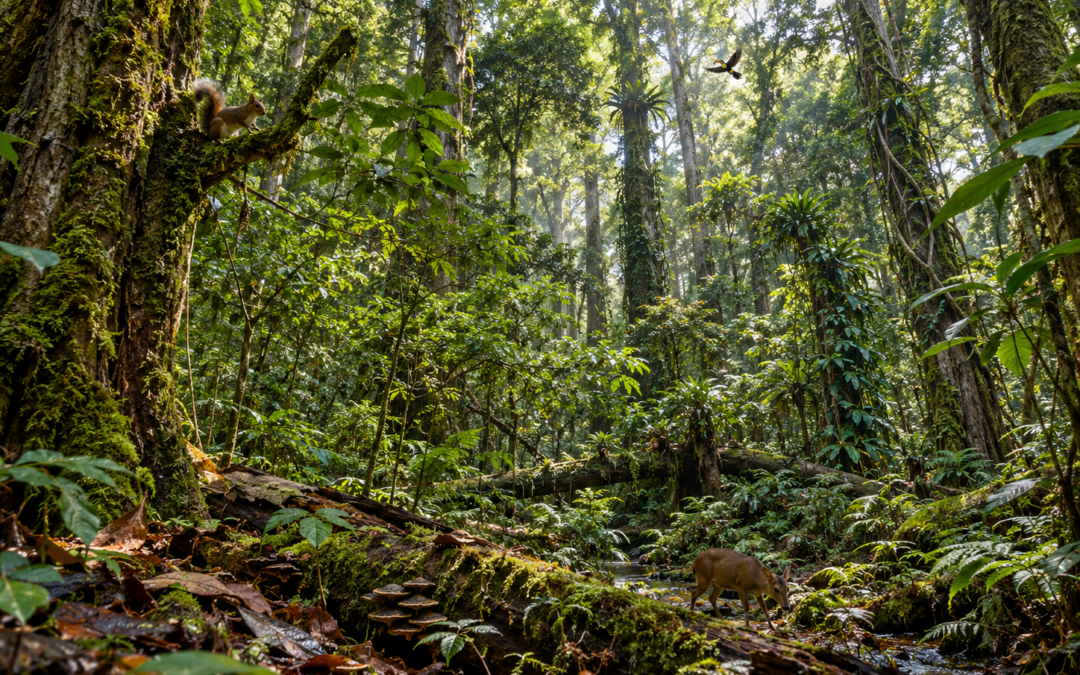
A forest is much more than a group of trees growing side by side. Vegetation is arranged vertically from the tallest crowns through smaller trees and shrubs to herbs, vines, fallen wood, and leaf litter on the forest floor. Each layer provides different combinations of food, shelter, nesting sites, temperature, light, and protection, allowing many wildlife species to occupy the same forest without depending on exactly the same resources.
This vertical arrangement has measurable importance for biodiversity. A U.S. Forest Service study using data from 2,546 North American Breeding Bird Survey routes found that combined vertical and horizontal habitat structure explained forest bird species richness particularly well, with an R² of 0.70. The finding shows that the height, arrangement, and complexity of forest vegetation can be just as important as the amount of forest itself.
Different Forest Layers Create Different Wildlife Niches
The highest trees form the main canopy and, in some forests, an emergent layer that rises above surrounding crowns. These exposed branches receive more sunlight and may offer nesting, resting, feeding, and hunting sites that are unavailable near the ground. Birds, insects, and tree-dwelling mammals use leaves, flowers, fruits, cavities, and branches at different heights depending on their needs.
Below the canopy is the understory, where light levels are lower and vegetation is generally shorter. Penn State Extension defines the understory as the lowest vegetation layer, including mosses, herbs, small shrubs, and ground-level vines. This layer creates dense shelter and feeding areas for insects, reptiles, birds, small mammals, and young trees waiting for opportunities to grow into canopy gaps.
The forest floor adds another distinct habitat. Leaf litter, fallen branches, logs, seeds, fungi, and decomposing organic matter provide food and shelter for microorganisms, insects, amphibians, reptiles, and mammals. Together, these vertical layers allow animals with different feeding, nesting, and shelter requirements to use the same forest in different ways.
Structural Complexity Supports More Wildlife
Forests containing trees of different sizes, ages, and forms generally provide a wider range of habitat features than simple, even-aged stands. Large trees may contain cavities and broad limbs, younger trees create intermediate layers, shrubs provide dense hiding cover, and fallen logs add structure near the ground. Forest Service guidance identifies live trees with decay, hollows, snags, logs, understory saplings, intermediate-sized trees, hardwoods, and brush as features that can provide nesting, roosting, hunting, and hiding opportunities.
The effect of this structural variety can be seen in wildlife studies. In research on green ash woodlands in South Dakota, 15 bird and mammal species occurred in significantly greater numbers in multilayered closed-canopy stands than in more open woodlands. Researchers also observed nearly twice as many birds in the multilayered closed-canopy stands.
That does not mean every species requires dense forest. Some wildlife depends on open woodland, young vegetation, edges, or early-successional habitat. The value of structural diversity comes from providing several habitat conditions within the wider landscape rather than trying to make every acre look the same.
Canopy Gaps Create New Habitat Conditions
Forests are continually changing as trees die, branches break, storms pass through, and new vegetation grows. When a canopy tree falls, additional sunlight reaches the forest floor and creates conditions that may favor shrubs, herbs, tree seedlings, and other plants. The U.S. Forest Service describes canopy gaps as a natural part of mature forest development that increases landscape diversity and creates local environments where new species can establish and grow.
Gap size influences what develops beneath the opening. A Forest Service experiment in northern hardwood forest found that ground-layer plant species diversity was higher in gaps than in uncut forest and was highest in medium-sized gaps about 20 to 30 meters in diameter. Different gap sizes alter light, temperature, soil moisture, and vegetation growth, creating a shifting mosaic of habitat conditions within the forest.
Canopy gaps can also benefit wildlife directly. Forest Service research notes that gaps can facilitate animal movement, while standing dead trees around those gaps provide breeding, roosting, and foraging sites. A healthy forest therefore often contains a mixture of closed canopy, small openings, young regeneration, standing dead trees, and fallen wood rather than one uniform vegetation structure.
Large Trees and Regeneration Maintain Forest Complexity
Large trees connect forest layers by providing trunks, branches, cavities, and climbing routes used by arboreal wildlife. As trees age, broken limbs, decay, hollows, and dead sections often create habitat features that younger trees do not yet provide. Retaining some mature trees, snags, and fallen logs while allowing younger trees and understory plants to develop helps maintain different stages of habitat in the same forest.
Disturbance can simplify or diversify this structure depending on its intensity. Severe logging, fire, hurricanes, and other events may remove large trees and temporarily reduce vertical complexity, while smaller disturbances can create openings that promote regeneration. Research on hurricane-created canopy gaps in the Southern Appalachians found that bird density and species richness were higher in gaps than in adjacent closed-canopy forest, showing that openings can add useful habitat when they remain part of a larger forested landscape.
The key is maintaining a mixture of structures over time. Large trees, younger regeneration, understory vegetation, canopy openings, dead standing trees, and fallen wood each serve different ecological functions. Protecting that variety allows forests to continue offering food, nesting sites, shelter, breeding areas, and movement pathways for wildlife across many stages of forest development.
Forest wildlife depends not only on how many trees are present, but also on how vegetation is arranged from the forest floor to the highest canopy. Maintaining multiple layers, mature trees, understory plants, canopy gaps, snags, fallen wood, and natural regeneration creates a richer collection of habitats than a structurally simple forest. Protecting that complexity helps sustain both wildlife diversity and the ecological processes that keep forests functioning over time.
Join the EAT Community at https://www.eatcommunity.com/ to learn from environmental professionals and explore practical strategies for forest ecology, conservation, and sustainable land management.