
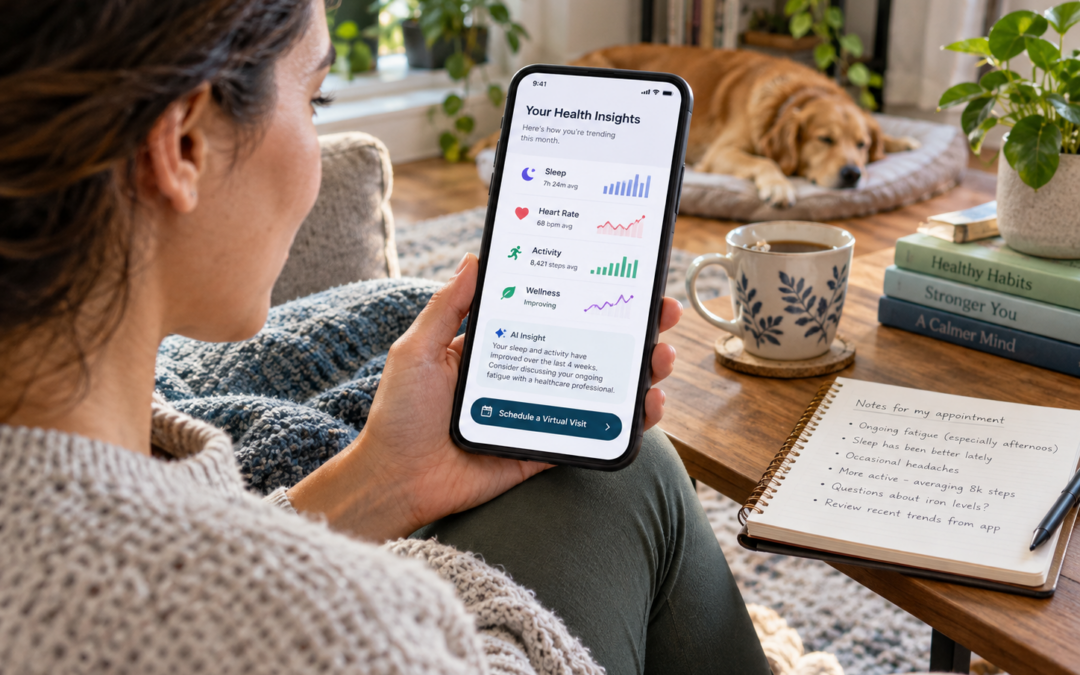
Some of the most expensive problems in healthcare begin long before a hospital admission or formal diagnosis.
They begin when a person notices that something does not feel right but waits.
Perhaps the symptom seems too minor to justify an appointment. Perhaps the person searches online, becomes overwhelmed by conflicting information, or simply assumes the problem will disappear.
Days become weeks. Weeks sometimes become months.
That delay matters.
The OECD estimates that misdiagnosis, underdiagnosis, and overdiagnosis together create direct costs equal to roughly 17.5% of healthcare expenditure in a typical OECD country.
That makes diagnostic safety more than a clinical issue. It is also an enormous economic issue.
This is where a new generation of consumer artificial intelligence tools becomes interesting.
Health applications are increasingly capable of combining information from wearables, sleep tracking, activity data, medical records, laboratory results, and conversations with users.
But the most important question may not be whether AI can produce another health score.
The more important question is whether it can help someone recognize that something has changed—and make it easier to seek appropriate professional help sooner.
That is the purpose of the “Coach” concept described in my forthcoming book, The Wrong Turn: How American Healthcare Lost Its Way and How We Find the Road Back.
Coach is not designed to replace a doctor.
It is designed to help people notice patterns, articulate what they are experiencing, and make the transition from “something doesn’t feel right” to a more useful conversation with a qualified human professional.
Consumer AI Health Coaching Is Growing Quickly
Technology companies are already moving rapidly into AI-assisted health coaching.
Today’s tools can combine information from wearable devices, fitness activity, sleep patterns, nutrition, laboratory results, and medical records.
Google Health Coach, for example, provides personalized guidance around areas such as exercise, nutrition, sleep, and mindfulness.
The larger trend is clear: consumer health software is moving beyond simply recording data.
It is beginning to interpret patterns.
Other emerging platforms are taking a similar approach by bringing together information that was previously scattered across different devices and applications.
This is potentially useful because health rarely changes in one isolated measurement.
Changes can develop gradually.
Sleep becomes less consistent.
Daily activity declines.
Energy drops.
Blood glucose trends upward.
Recovery worsens.
One measurement may mean very little.
A pattern developing over several weeks may mean considerably more.
That is where longitudinal AI systems could become genuinely useful.
AI Coaching Can Work in Some Health Programs
There is already evidence that AI-guided programs can perform useful functions in carefully defined settings.
A randomized clinical trial led by researchers affiliated with Johns Hopkins compared a fully automated AI-powered Diabetes Prevention Program with a traditional human coach-led program.
At 12 months, participants in the AI-led and human-led programs achieved very similar rates on the study’s primary composite health outcome.
That does not mean artificial intelligence can replace clinicians.
It means that for some highly structured behavioral programs, AI may be capable of delivering guidance that previously required substantial human coaching time.
That distinction matters.
Helping someone follow an established nutrition, exercise, or weight-management program is very different from diagnosing an unexplained symptom.
A responsible health AI system needs to know the difference.
The Key Gap: Coaching Versus Keeping People Inside an App
Most technology businesses are rewarded when people continue using their products.
More time in the application usually means more engagement.
More engagement can mean higher retention, additional subscriptions, and more valuable user data.
That business model creates an important question for health technology.
What happens when the best outcome for the user is to leave the app and speak with a human professional?
That is where the Coach concept differs from a conventional consumer wellness application.
Its goal is not to become the destination.
Its goal is to help create a better handoff.
Imagine that someone has mentioned low energy several times over six weeks.
At the same time, the person’s sleep has deteriorated, activity levels have declined, and another symptom has appeared.
None of those signals individually needs to produce a diagnosis.
The AI does not need to say:
“You have this disease.”
Instead, it could say:
“You’ve mentioned persistent fatigue several times, and some of your other health patterns have also changed. It may be worth discussing these changes with a healthcare professional. Here is a concise summary of what has changed and when.”
That is a fundamentally different product philosophy.
The AI is not trying to become the doctor.
It is trying to make the next conversation with the doctor better.
The Best AI Health Coach Should Know Its Limits
A useful Coach would need to distinguish among several kinds of situations.
Some observations require nothing more than a lifestyle suggestion.
Others may deserve monitoring.
Some should trigger a recommendation to schedule an ordinary professional consultation.
And certain warning signs should tell the user to seek urgent medical attention.
This means that restraint is just as important as intelligence.
A system that constantly warns users about every abnormal measurement could create anxiety and unnecessary healthcare use.
A system that minimizes potentially important signals could create the opposite problem.
The challenge is not merely identifying abnormalities.
It is providing proportionate guidance.
That requires careful clinical design, validated escalation rules, and clearly defined boundaries around what the system can and cannot do.
Privacy Must Be Part of the Product Design
Longitudinal health coaching creates another challenge: privacy.
A useful proactive Coach may need to recognize patterns across weeks or months.
That could involve information about:
- Sleep
- Exercise
- Heart rate
- Nutrition
- Laboratory results
- Symptoms
- Medications
- Medical history
- Stress
- Mood
- Personal circumstances
That makes the privacy architecture of the product extremely important.
Many consumers assume that any digital tool involving healthcare information is automatically covered by the same privacy rules that govern their doctor’s office.
That is not necessarily true.
General-purpose AI systems and many consumer applications may operate outside traditional HIPAA-covered healthcare relationships.
A responsible health coaching system therefore needs clear answers to basic questions.
What data is collected?
Why is it being collected?
Where is it stored?
How long is it retained?
Who can access it?
Can the user delete it?
Can the user choose which information the Coach is allowed to use?
Can information be shared with a clinician only after the user gives permission?
Those questions cannot be treated as an afterthought.
For a system designed to understand health patterns over long periods of time, trust must be engineered into the product from the beginning.
The Human Handoff Is the Most Important Feature
The most useful feature of a health Coach may ultimately be something surprisingly simple:
the ability to prepare someone for a better human conversation.
Many patients struggle to explain what has happened.
They remember the symptom but not when it started.
They forget whether it happens every day or only occasionally.
They arrive at an appointment without the information that would help the clinician understand the pattern.
A properly designed Coach could help organize that information.
Before the appointment, it might produce a short summary:
- When the symptom began
- How frequently it occurs
- Whether it is getting better or worse
- Related changes in sleep or activity
- Relevant measurements
- Questions the patient wants to ask
The clinician still evaluates the patient.
The clinician still diagnoses.
The clinician still decides what testing or treatment is appropriate.
But both people begin the conversation with better information.
That could be a far more meaningful use of AI than simply creating another wellness score.
CES Is Becoming an Important Place to Watch This Shift
The evolution from passive tracking to active AI assistance is also visible in the broader digital-health industry.
CES has increasingly featured discussions about agentic AI in healthcare—systems capable of doing more than simply answering questions.
The larger question is how much responsibility those systems should have.
There is an enormous difference between an AI that says:
“Your sleep was worse this week.”
and one that says:
“Based on several changes occurring together, consider contacting your healthcare provider.”
Moving from information to action creates greater potential value.
It also creates greater responsibility.
That is why the next generation of health AI should be judged by more than technical sophistication.
A Better Test for Consumer Health AI
When evaluating a health coaching product, we should ask several questions.
Does it help users understand meaningful changes over time?
Does it clearly explain the limits of its advice?
Does it protect sensitive information?
Does it recognize situations that require professional attention?
Can users control what data is collected and shared?
And perhaps most importantly:
Does the product know when its job is finished?
A good consumer health AI should not measure success only by how long someone stays inside the application.
Sometimes success should mean helping a person recognize that it is time to leave the app and call a professional.
The “Coach” Model
That is ultimately the philosophy behind Coach in The Wrong Turn.
The goal is not artificial intelligence replacing the healthcare relationship.
The goal is AI improving the moments between healthcare encounters.
It can help someone remember.
It can help someone recognize patterns.
It can help someone organize observations.
It can help someone decide that a conversation is worth having.
And when that conversation becomes necessary, it can help the user arrive better prepared.
That distinction becomes increasingly important as consumer health AI grows more capable.
The future of health technology should not be measured simply by whether an AI can keep someone engaged.
It should be measured by whether the technology helps the individual make better decisions about when human care is needed.
Conclusion
Consumer AI health coaching has real potential.
Wearables, health records, laboratory information, and conversational AI can give people access to more information about themselves than any previous generation has had.
But having more information is not the same as receiving better care.
The most important opportunity may be building AI systems that recognize meaningful patterns early, communicate them calmly, respect privacy, and help users make the transition to appropriate professional care.
That is the central test for the next generation of digital health.
Does the AI simply become another application competing for our attention—or does it help us recognize when it is time to talk to another human being?
That is the difference between an engagement tool and a genuine health Coach.

Robert Christadore is the author of the forthcoming book The Wrong Turn: How American Healthcare Lost Its Way and How We Find the Road Back and covers sustainability and technology for The EAT Community.