
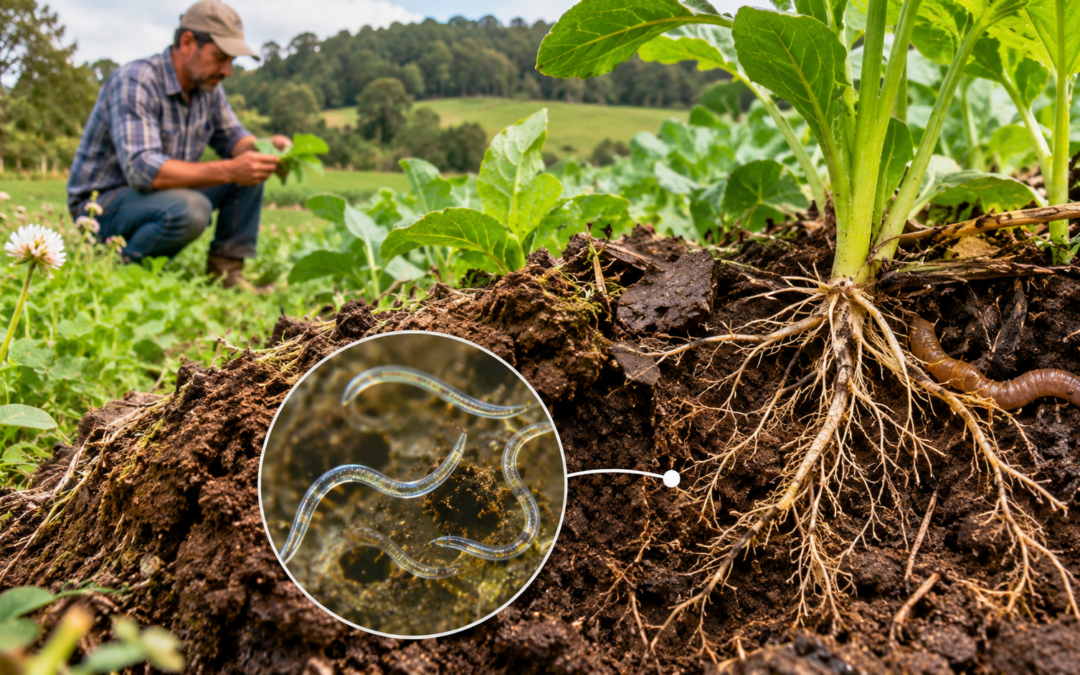
Nematodes are microscopic roundworms found in nearly every agricultural soil, but they are often discussed only as crop pests. In reality, most soil nematodes do not attack plants. Many feed on bacteria, fungi, other nematodes, or insects and perform useful functions within the soil food web. USDA Natural Resources Conservation Service guidance notes that healthy pasture soils can contain more than 100,000 nematodes per square meter.
That diversity makes nematodes relevant to regenerative agriculture. Bacterial- and fungal-feeding species help recycle nutrients, predatory species influence populations of other soil organisms, and entomopathogenic nematodes attack susceptible insects. Their activity is strongly affected by moisture, temperature, living roots, organic resources, and the biological complexity of the surrounding soil.
Beneficial Nematodes Help Recycle Nutrients
Bacteria and fungi store nutrients inside their cells while decomposing organic matter. When bacterial- and fungal-feeding nematodes consume those organisms, they use part of the nutrients for growth and release the remainder back into the soil in plant-available forms. NRCS describes nematodes as grazers that release plant-available nutrients as they consume bacteria and fungi.
Nitrogen cycling is especially important. USDA guidance explains that nematodes help release ammonium as they consume microbes, and that ammonium can subsequently be converted to nitrate for plant uptake. This places nematodes between soil microorganisms and crop roots in the nutrient cycle rather than treating them as isolated organisms.
Research cited in a USDA nutrient-cycling guide found that nematodes may consume up to 25% of soil bacteria. The same source cites research in which bacterial-feeding nematodes accelerated litter decomposition by 23%. These interactions help explain why a diverse soil food web can affect nutrient availability even when farmers never see most of the organisms performing the work.
Some Nematodes Provide Biological Pest Control
A different group of beneficial nematodes attacks insects rather than microbes. Species in the genera Steinernema and Heterorhabditis are called entomopathogenic nematodes and are used as biological controls against susceptible soil-dwelling insect pests. They enter an insect host and release symbiotic bacteria that rapidly kill it, allowing the nematodes to reproduce inside the body.
USDA Agricultural Research Service describes beneficial insect-killing nematodes as environmentally friendly biopesticides that locate and attack insect pests in soil. Unlike plant-parasitic nematodes, these species do not feed on crop roots. Their value lies in attacking particular insect hosts as part of an integrated pest-management system.
They are not effective against every pest. University of Minnesota Extension recommends Steinernema and Heterorhabditis for certain insect problems such as iris borers, while emphasizing that the nematodes require moist conditions to survive and move. Effectiveness therefore depends on matching the nematode species to the target insect and applying it under suitable conditions.
Beneficial nematodes can reduce dependence on conventional insecticides for some pests, but they should not be treated as a universal substitute. Correct identification of the insect pest, application timing, soil moisture, temperature, and product viability all influence whether biological control succeeds.
Soil Conditions Determine Whether Nematodes Thrive
Beneficial nematodes live within thin films of water around soil particles, so moisture is fundamental to their movement and survival. Colorado State University Extension identifies adequate moisture as the most important environmental requirement for insect-parasitic nematodes and recommends irrigating before and after some soil applications.
Temperature also matters. CSU reports that brief exposure above approximately 90°F to 95°F can kill commonly available strains of Steinernema carpocapsae, while temperatures below about 55°F can greatly reduce the activity of many Heterorhabditis species. Different species and strains respond differently, so application conditions need to match the organism being used.
Organic matter affects nematodes indirectly by supporting bacteria, fungi, roots, and other food-web organisms. USDA ARS describes soil nematodes as important nutrient recyclers and notes that moisture, temperature, oxygen, soil texture, pH, and organic substrate quality all influence decomposition and soil-food-web activity.
This means adding organic matter does not simply “feed nematodes” directly. Instead, crop residues, living roots, compost, and other organic resources influence the microbial and biological communities on which many nematode species depend. Different management practices can therefore favor different groups rather than increasing every nematode population equally.
Regenerative Practices Can Support a More Diverse Soil Food Web
Regenerative farming practices are generally aimed at maintaining habitat for a broad community of soil organisms rather than managing one species at a time. Living roots, crop rotations, cover crops, reduced disturbance, and organic residues provide varied resources throughout the year. NRCS’s Soil Biology Primer emphasizes that soil organisms are central to decomposition, nutrient cycling, soil structure, water availability, and crop protection.
Reduced disturbance can be especially important because intensive management simplifies soil habitat. USDA research notes that high-input systems tend to favor simpler bacterial-dominated food webs, while more heterogeneous, lower-input systems may support a more complex mixture of fungal pathways and soil microfauna. That does not mean eliminating every tillage or crop-protection practice, but it does support the regenerative principle of avoiding unnecessary disturbance.
Nematode communities can also tell researchers something about soil condition. USDA-supported soil-health research specifically evaluates nematode community structure as an indicator of overall soil quality and nutrient cycling. A soil dominated by plant-parasitic species presents a very different picture from one containing diverse bacterial feeders, fungal feeders, predators, and omnivores.
Farmers should therefore distinguish beneficial nematodes from damaging plant-parasitic species. The goal is not simply to increase the total number of nematodes, but to maintain a diverse and functional soil community while managing the species that damage crops. Maintaining living roots, sufficient moisture, diverse rotations, organic matter, and reduced unnecessary disturbance creates better habitat for many of the organisms that make a healthy soil food web work.
Beneficial nematodes are easy to overlook because most are too small to see without magnification. Yet they participate in nutrient recycling, interact with bacteria and fungi, regulate other soil organisms, and in some cases provide targeted biological control of insect pests. Regenerative farming practices that maintain diverse, biologically active soils help preserve these functions while supporting the wider network of organisms on which crop productivity depends.
Join the EAT Community at https://www.eatcommunity.com/ to learn from experienced farmers and explore practical strategies for regenerative farming.