
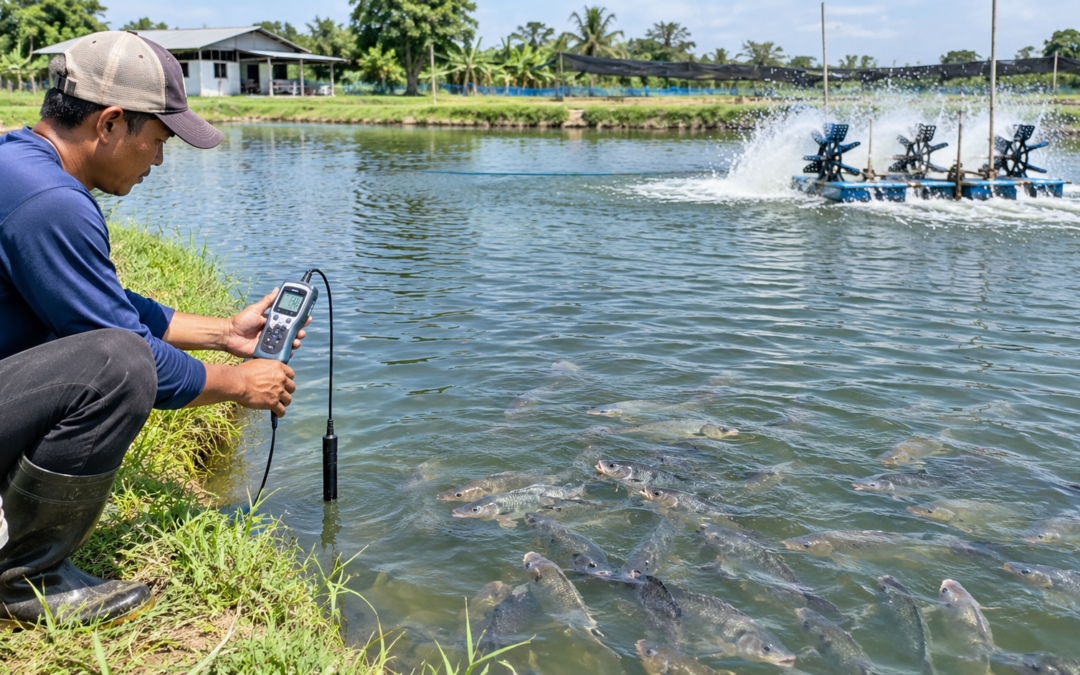
Water quality is one of the most important factors in successful fish production. Fish live continuously in the water around them, so changes in dissolved oxygen, temperature, pH, ammonia, and organic matter directly affect feeding, growth, stress, and survival. Mississippi State University Extension explains that poor water quality in catfish ponds can reduce growth, worsen feed conversion, lower disease resistance, and, in severe cases, cause fish deaths.
Good water-quality management is therefore less about reacting to emergencies and more about recognizing problems early. Farmers who monitor ponds routinely can often identify falling oxygen, excessive nutrients, ammonia buildup, or unstable pH before fish show obvious signs of stress. Aeration, appropriate stocking, careful feeding, waste control, and gradual water exchange can then be used to restore more stable conditions.
Dissolved Oxygen and Temperature Drive Fish Performance
Dissolved oxygen deserves close attention because fish, phytoplankton, bacteria, and other pond organisms all depend on it. In productive ponds, oxygen usually falls overnight because photosynthesis stops after sunset while respiration continues. Mississippi State University Extension reports that mechanical aeration in commercial catfish ponds is commonly started when dissolved oxygen falls to around 3 to 4 milligrams per liter.
Temperature affects the same system because warmer water holds less dissolved oxygen while fish and microorganisms generally consume oxygen more rapidly. Oklahoma State University notes that the solubility of oxygen decreases as water temperature increases. This combination makes hot summer weather particularly important for farmers managing ponds with high fish biomass or heavy feeding rates.
Fish behavior can provide early warning signs, but farmers should not wait for fish to begin gasping. Mississippi State reports that under intensive production conditions, catfish ponds may fall below 2 milligrams per liter of dissolved oxygen at dawn during midsummer. Regular early-morning testing and having aeration equipment ready can reduce the chance that low oxygen develops into a major fish-loss event.
pH and Ammonia Need Regular Monitoring
Pond pH influences both fish physiology and the chemistry of other water-quality variables. Mississippi State University Extension identifies a pH range of 6.5 to 9.0 as optimum for fish ponds. The same guidance recommends alkalinity of at least 20 parts per million to provide enough buffering to reduce large daily pH swings.
Ammonia is another critical water-quality concern because fish continuously release it as a metabolic waste product. The University of Florida IFAS explains that feed digestion is a major source of ammonia in aquaculture systems and that overfeeding is a major cause of high ammonia concentrations. The more toxic un-ionized form of ammonia also becomes more abundant as pH and temperature increase, so ammonia results should always be interpreted together with those measurements.
Ammonia problems should be addressed quickly. UF/IFAS reports that un-ionized ammonia above 0.05 milligrams per liter can damage fish tissue, and prolonged exposure can make fish more susceptible to disease. When ammonia is detected, reducing or temporarily stopping feed is often the first response because additional feeding increases the nutrient load the pond must process.
Feeding, Nutrients, and Organic Waste Affect the Whole Pond
Feed is essential for fish production, but not all of its nutrients become fish biomass. Mississippi State University Extension explains that nutrients from feed and fish wastes stimulate phytoplankton growth, and dense phytoplankton populations create pronounced daily changes in dissolved oxygen, carbon dioxide, and pH. These fluctuations can stress fish and reduce growth and feed conversion even before a dramatic water-quality emergency develops.
Heavy phytoplankton growth is particularly important because it increases both daytime oxygen production and nighttime oxygen demand. Mississippi State notes that the combined respiration of fish, phytoplankton, and organisms living in pond mud can place tremendous demand on dissolved oxygen. In intensively managed catfish ponds, low nighttime oxygen may persist for 3 to 6 hours per day during midsummer.
Uneaten feed, dead algae, fish waste, and plant material also accumulate and decompose. Bacteria consume oxygen during decomposition while nutrients are returned to the water, potentially encouraging more phytoplankton growth. Careful feeding therefore improves more than feed efficiency; it also helps control organic waste, oxygen demand, ammonia, and nutrient loading throughout the pond.
Use Aeration and Water Exchange as Management Tools
Aeration is one of the most practical tools available for managing oxygen risk. It adds oxygen to the water and improves circulation, helping farmers respond when biological oxygen demand becomes greater than natural oxygen production. Mississippi State recommends beginning aeration before oxygen reaches dangerously low levels, using routine measurements rather than waiting until fish are visibly distressed.
Water exchange can also help with certain water-quality problems, particularly ammonia, but it is not practical in every production system. University of Florida IFAS states that a 25% to 50% water change can help remove ammonia when the incoming water itself does not contain ammonia. The guidance also stresses that this approach is practical mainly for tanks or very small ponds rather than large commercial production ponds.
Feeding adjustments can be equally important during an ammonia problem. UF/IFAS states that reducing or stopping feed for approximately 1 to 3 days will generally not harm fish other than very young fry and gives the pond’s nitrogen cycle time to catch up with the nutrient load. In larger ponds, routine monitoring, aeration, responsible feeding, stocking management, and biological nutrient cycling remain more practical long-term tools than trying to replace large volumes of water.
Fish pond water quality is constantly changing, which makes regular observation and testing essential. Dissolved oxygen, temperature, pH, ammonia, nutrients, phytoplankton, and organic matter interact, so a change in one condition can quickly influence several others. Farmers who monitor consistently and respond early are better positioned to maintain feeding, growth, fish health, and dependable production.
Join the EAT Community at https://www.eatcommunity.com/ to learn from experienced farmers and explore practical strategies for regenerative farming.